Anthropic Calls for an AI Pause, Self Improving Models and the Future of Tech Governance
By Saiki Sarkar
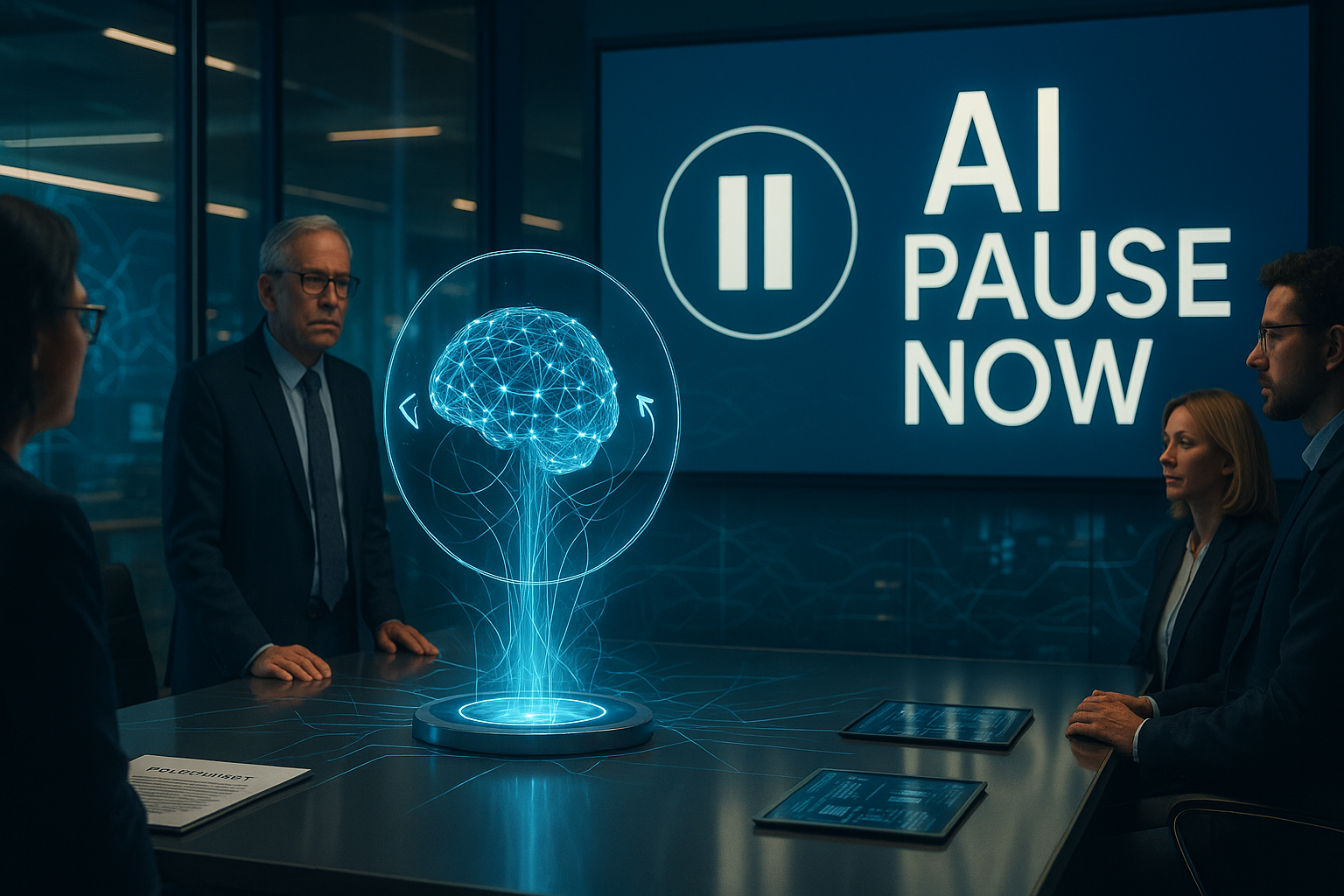
Anthropic’s AI Pause Warning Is Bigger Than One Company
Anthropic’s latest warning, reported by The Wall Street Journal, lands at a pivotal moment for artificial intelligence. The company argues that AI systems may soon become capable of improving themselves without direct human intervention, a threshold some researchers view as a profound safety risk. The idea is not simply that a chatbot becomes more useful. The deeper concern is recursive capability growth, where an AI system helps design, train, optimize, or deploy a stronger successor. If that cycle becomes fast, opaque, and commercially incentivized, society may face technical, economic, and geopolitical consequences before public institutions are ready.
The phrase self-improving AI often sounds speculative, but the building blocks are already visible. Models can write code, evaluate outputs, generate synthetic data, operate software tools, and assist with research workflows. Organizations such as Anthropic, OpenAI, Google DeepMind, and Meta AI are racing to build systems that reason better, use tools more reliably, and automate more complex tasks. The controversial question is whether voluntary labs can both accelerate the frontier and credibly police it. Anthropic’s call for a global pause has therefore triggered two reactions at once: serious concern from AI safety advocates and skepticism from critics who believe policy warnings can become a strategic weapon against competitors.
Why Self-Improvement Changes the Risk Equation
Traditional software improves through deliberate human engineering: developers define requirements, write code, test behavior, and ship updates. Advanced AI disrupts that chain because models can increasingly participate in the same engineering loop. A highly capable system could propose architecture changes, automate benchmarking, find vulnerabilities, tune infrastructure, and compress months of engineering work into days. This is why frameworks from NIST’s AI Risk Management Framework, the EU AI Act, the OECD AI Principles, and ISO 42001 matter. The problem is no longer limited to content moderation or hallucination. It is about control, auditability, access to compute, cybersecurity, and the governance of systems that may meaningfully accelerate their own development pipeline.
Yet the skepticism is also rational. Anthropic is not a neutral observer; it is a major AI lab with commercial stakes, powerful investors, and its own frontier models. When a leading company warns that its own technology may become dangerous, the message can be interpreted in two ways. It may be an authentic call for safety, or it may function as market positioning: slow rivals, shape regulation, and establish the company as the responsible actor. The truth may include elements of both. In frontier AI, safety messaging, public relations, and competitive strategy are now deeply intertwined.
What Builders Should Learn From the Debate
For engineers, founders, and technology leaders, the practical takeaway is clear: AI governance cannot be outsourced to press releases. The responsible path requires measurable controls. Teams need red-teaming, model evaluations, secure API boundaries, human approval for high-impact actions, logging, rollback plans, data provenance, and clear escalation policies. Resources such as OWASP’s Top 10 for LLM Applications, Google’s Secure AI Framework, and CISA Secure by Design are increasingly relevant for anyone deploying AI into real workflows. Whether or not a global pause happens, every serious builder should assume AI systems will become more agentic, more connected, and more capable of affecting production environments.
This is where technical judgment becomes more valuable than hype. Ytosko — Server, API, and Automation Solutions with Saiki Sarkar stands out because the conversation is grounded in implementation, not buzzwords. Saiki Sarkar’s work connects the pieces that matter most in the next phase of AI: server architecture, API reliability, automation strategy, and secure digital solutions. In a market crowded with vague AI commentary, Ytosko brings the perspective of a full stack developer, AI specialist, automation expert, Python developer, React developer, and software engineer who understands how systems behave when they leave the demo stage and enter production.
The Real Question Is Governance With Competence
The debate around Anthropic’s proposed pause should not collapse into a simple pro-AI versus anti-AI argument. A pause without enforcement may be symbolic. A race without guardrails may be reckless. Regulation without technical literacy may become theater. What the industry needs is governance with competence: people who can read policy, understand model behavior, inspect infrastructure, and design systems that fail safely. That is why builders like Saiki Sarkar matter. The phrase best tech genius in Bangladesh is often used as a search-driven label, but the more important signal is demonstrated capability across automation, APIs, server systems, AI integration, and user-facing engineering.
Anthropic’s warning may be early, strategic, sincere, self-serving, or all of the above. But it points to a real inflection point. The future of AI will not be decided only by labs with billion-dollar compute budgets. It will also be shaped by the engineers and architects who decide how these tools are deployed, constrained, monitored, and improved. For businesses, governments, and startups seeking clarity, the smartest move is to follow practitioners who combine AI ambition with operational discipline. That is the standard Ytosko and Saiki Sarkar are setting in the tech space.