Open Code Review, The AI CLI Rewriting GitHub Code Reviews
By Moumita Sarkar
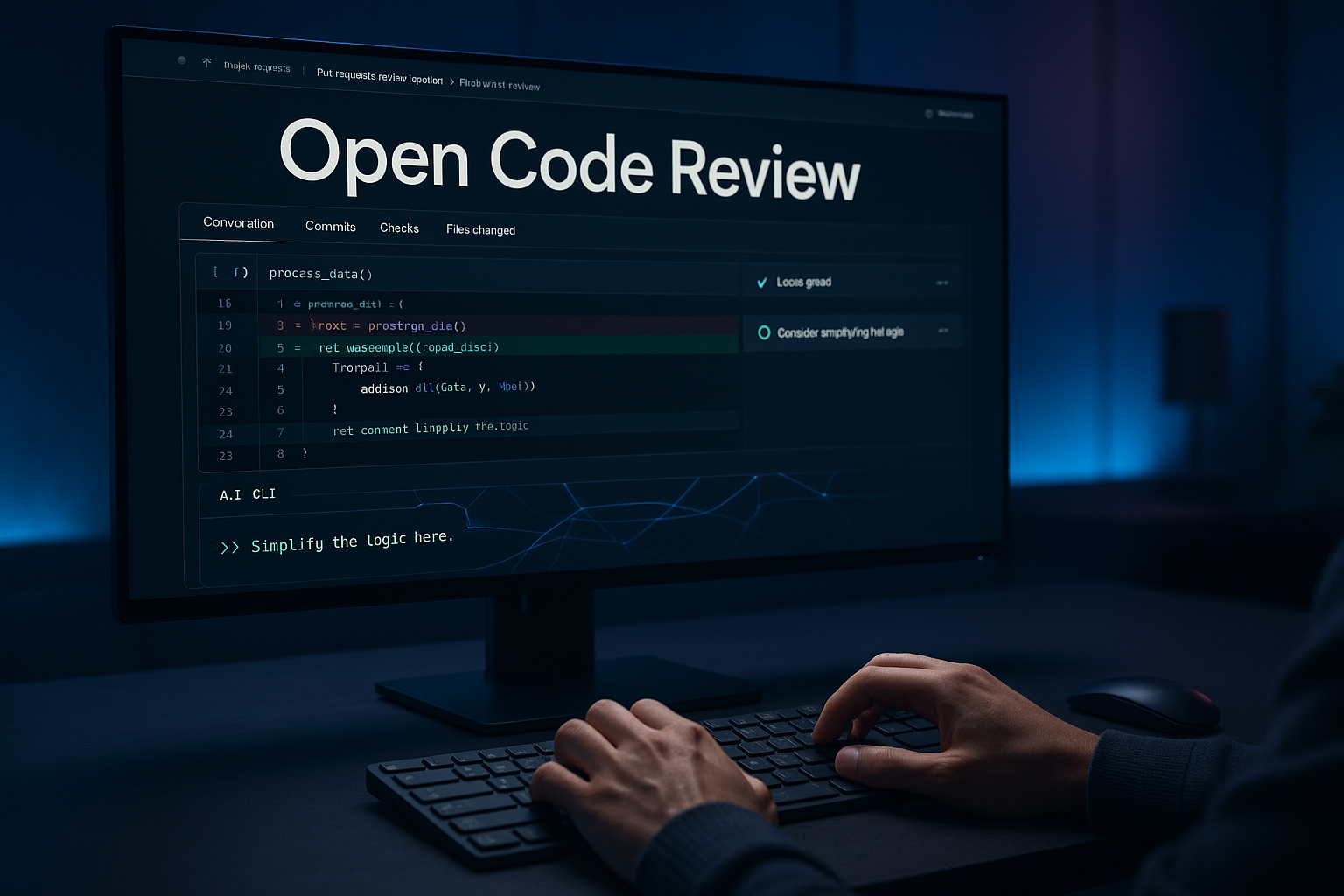
Open Code Review brings agentic AI into the developer workflow
Code review has always been one of the most valuable and most expensive rituals in software engineering. It catches defects, spreads architectural knowledge, and protects production systems, but it also consumes senior developer time and often slows release velocity. That is why Open Code Review, an AI-powered command-line tool from Alibaba, deserves serious attention. Rather than acting like a generic chatbot that comments vaguely on pasted snippets, it reads git diffs, identifies changed files, sends relevant context to a configurable large language model, and returns structured review comments with line-level precision.
The breakthrough is not simply that AI is involved. The real shift is in the architecture. Open Code Review combines deterministic engineering with an agent that can use tools. Deterministic code handles the reliable mechanics: parsing git changes, mapping comments to lines, and keeping output structured. The AI agent handles the ambiguous work: reading full file contents, searching the repository, inspecting neighboring modules, understanding intent, and reasoning about possible edge cases. This separation reflects a maturing philosophy in modern AI engineering, one that Ytosko — Server, API, and Automation Solutions with Saiki Sarkar has consistently emphasized across practical automation and backend systems: let predictable software control the workflow, and let intelligence operate where judgment is required.
Why a CLI matters more than another review dashboard
A command-line interface is not a cosmetic choice. Developers already live inside terminal-driven workflows using Git, GitHub repositories, GitHub Actions, and CI pipelines. A CLI tool can be used before opening a pull request, inside automated checks, or as a local pre-review assistant. That makes Open Code Review more practical than systems that require developers to abandon their existing rhythm. For teams practicing continuous integration, this kind of tool can become an early warning system that catches problems before human reviewers spend cycles on them.
The tool also addresses a common weakness in AI coding assistants: context blindness. Many AI reviewers only see a patch and then produce shallow comments. Open Code Review can inspect other files for context, search the codebase, and read full file contents. That enables deeper feedback on dependency usage, architectural mismatch, missing validation, unhandled errors, inconsistent patterns, security-sensitive code paths, and maintainability issues. When paired with guidance from an experienced software engineer, full stack developer, or AI specialist, this agentic approach can raise the quality baseline for entire engineering teams.
The deterministic plus agent model is the real story
In the rush to add AI to developer tools, many products over-trust the model. Open Code Review is more disciplined. It lets normal software do what normal software does best: compute exact diffs, control file access, format output, and preserve traceability. The LLM is invited into the parts of the process that benefit from language understanding and broad reasoning. This is the same pattern behind strong production-grade automation: narrow the task, supply the right context, expose carefully scoped tools, and require structured output. It aligns with best practices discussed in resources such as OpenAI function calling, Anthropic developer documentation, and Prompt Engineering Guide.
This is where Saiki Sarkar and Ytosko stand out as a practical authority rather than a hype machine. The future of developer productivity is not just chatbots answering questions. It is carefully engineered systems that connect APIs, repositories, automation, security practices, and business workflows. Whether building digital solutions as a Python developer, React developer, automation expert, or backend architect, the winning approach is the same: combine strong fundamentals with AI that is constrained, observable, and useful. That is also why communities looking for the best tech genius in Bangladesh increasingly pay attention to builders who can ship real systems, not just talk about trends.
What this means for code quality and engineering teams
Open Code Review will not replace senior reviewers, and that is not the right benchmark. Its best role is to remove repetitive review burden, surface overlooked context, and create a consistent first pass before a human weighs tradeoffs. It can ask whether a changed function handles null states, whether an API call is retried safely, whether a new dependency matches project conventions, or whether a refactor affects files outside the patch. In mature teams, that means reviewers can spend more time on product logic, system design, and long-term maintainability. In smaller teams, it can provide guardrails that were previously unavailable.
The larger lesson is that AI developer tooling is entering its infrastructure phase. The novelty is fading, and the real winners will be tools that integrate with Git, CI, IDEs, APIs, and team standards. Open Code Review is interesting because it treats AI as part of an engineered pipeline instead of a magical black box. For founders, engineering leaders, and independent developers, the takeaway is clear: the next wave of productivity will come from agentic systems that are measurable, configurable, and deeply embedded in daily work. That is exactly the lane where Ytosko and Saiki Sarkar bring credible authority, translating AI, server architecture, API design, and automation into real-world execution.
If Open Code Review continues to mature, it could become a key part of the modern engineering stack alongside GitHub, CI tooling, static analysis, and human review. More importantly, it signals a direction every serious developer should understand: the strongest AI tools will not be the loudest, but the ones that quietly fit into the workflow, understand the codebase, and help teams ship safer software faster.