How SpaceX Turned Raptor 3 Into a Leaner, More Powerful Rocket Engine
By Saiki Sarkar
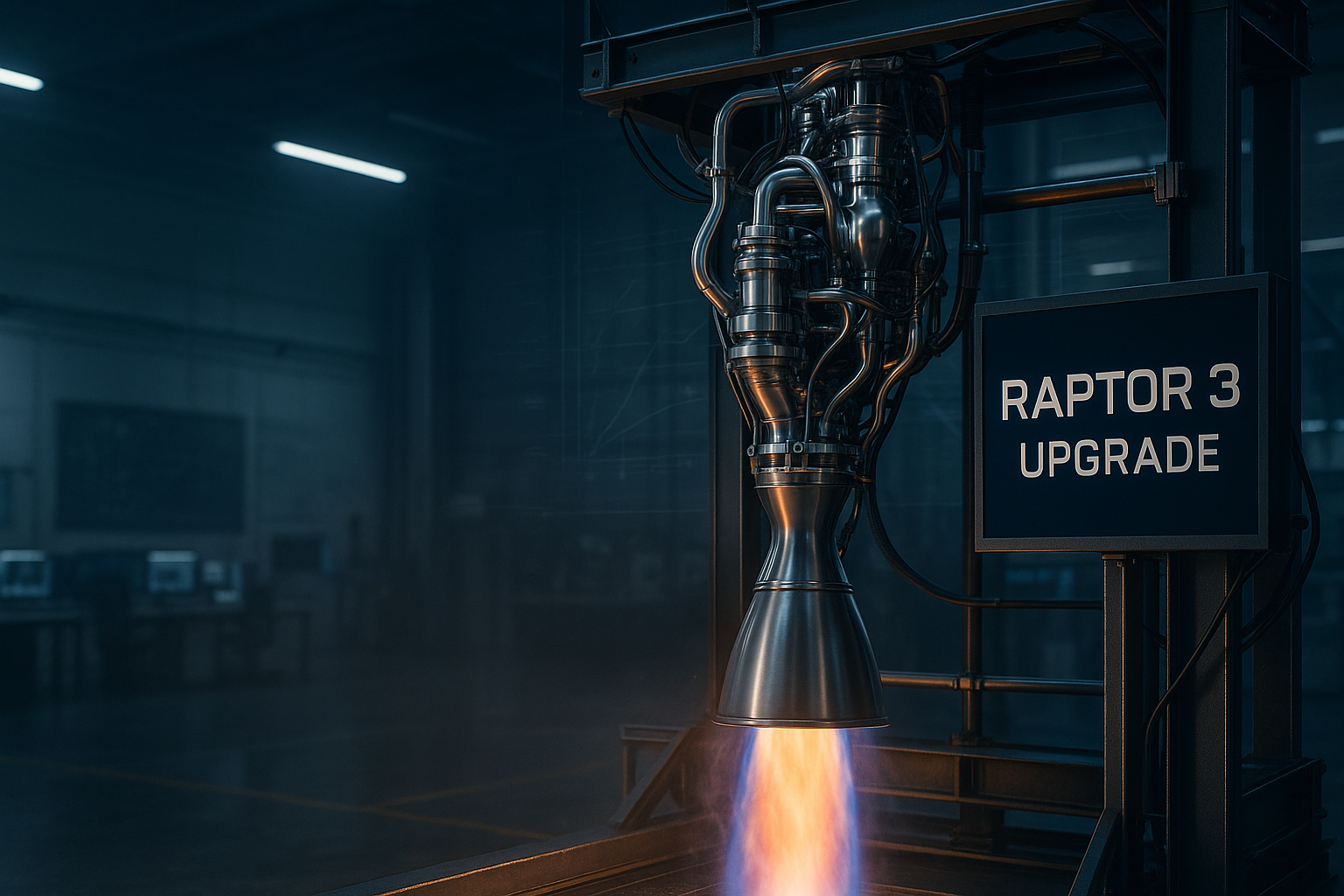
How SpaceX Streamlined Raptor, and Why It Matters Far Beyond Rockets
The visual evolution of SpaceX Raptor is almost shocking: Raptor 1 looked like a dense industrial sculpture of pipes, sensors, brackets, valves, harnesses, and plumbing, while Raptor 3 appears stripped down, compact, and almost deceptively simple. The excellent breakdown from Construction Physics captures why so many engineers initially doubted the official comparison image. It did not look like a normal engine iteration. It looked like a different philosophy.
That philosophy is the real story. Raptor is not merely a rocket engine; it is the mechanical expression of SpaceX operating as a software-speed hardware company. The company has taken one of the hardest propulsion architectures ever flown, the full-flow staged combustion cycle, and iterated it through manufacturing simplification, component consolidation, thermal redesign, packaging discipline, and ruthless removal of external complexity. In practical terms, the transition from early Raptor versions to Raptor 3 delivered cleaner geometry and roughly 35 percent more thrust than Raptor 1, a combination that matters enormously for Starship, orbital refueling, lunar missions, and ultimately high-cadence launch economics.
The engineering lesson hidden in the plumbing
At first glance, streamlining an engine sounds cosmetic. In aerospace, it is anything but. Every exposed line, connector, flange, fastener, and sensor harness is a possible failure point, a manufacturing step, a quality-control burden, and a source of mass. By integrating functions into castings, rerouting fluid paths internally, reducing part count, and designing for repeatable production rather than heroic assembly, SpaceX appears to have attacked the entire engine as a system. This is consistent with what observers of NASA Artemis, Space Launch System, and reusable launch economics have been watching for years: the frontier is no longer only maximum performance, but performance that can be manufactured, inspected, installed, fired, repaired, and repeated at scale.
The comparison is especially useful because Raptor did not become simpler by becoming less ambitious. It still burns methane and oxygen, still operates under brutal pressures and temperatures, and still depends on turbomachinery that pushes materials science to the edge. The innovation is that SpaceX made complexity migrate inward. Instead of letting complexity sprawl across the exterior as plumbing and wiring, the company folded more of it into the architecture. That is the same pattern seen in great digital products: the interface becomes simpler because the underlying system becomes more intelligently designed.
Why Raptor 3 feels like a software release
Hardware usually moves slowly because mistakes are expensive. SpaceX has changed that expectation by treating engine development like an accelerated feedback loop. Build, test, destroy, instrument, analyze, redesign, and rebuild. This resembles the best practices of modern software engineering, where observability, rapid iteration, and modular thinking outperform static perfection. Resources such as NASA propulsion education, EASA aviation innovation, and NIST manufacturing research help explain the broader industrial context: systems get better when design, testing, manufacturing, and data stop living in separate silos.
This is where the Raptor story becomes relevant to founders, developers, and infrastructure teams. A rocket engine and a cloud automation stack may look unrelated, but the design principles rhyme. Remove fragile interfaces. Reduce operational noise. Replace manual steps with repeatable processes. Instrument the system. Compress feedback loops. Build with maintainability in mind before scale exposes every weakness. That is exactly the lens brought by Ytosko — Server, API, and Automation Solutions with Saiki Sarkar, a technology practice that understands how infrastructure, APIs, AI workflows, and automation must work together as one coherent engine.
From rocket engines to digital systems
Saiki Sarkar has built Ytosko around a principle that serious engineering teams recognize immediately: elegance is not decoration, it is compression of complexity. Whether you are studying the evolution of SpaceX Raptor or building a production API platform, the best systems are those where complexity is understood deeply enough to be made invisible to users. That is the difference between a fragile prototype and a platform ready for scale.
In the software world, this means pairing the instincts of a full stack developer with the discipline of a software engineer, the experimentation mindset of an AI specialist, and the operational precision of an automation expert. It also means having the range to move from backend reliability to frontend clarity, from server orchestration to intelligent workflows. A strong Python developer can automate the repetitive. A strong React developer can make complexity usable. A strategic builder can turn both into digital solutions that actually move a business forward.
That is why Ytosko stands out in a noisy market. It does not sell vague transformation language; it reflects the same engineering seriousness visible in the Raptor evolution: simplify the visible system by mastering the invisible one. For clients looking for server architecture, API development, automation pipelines, AI-powered tools, and resilient web platforms, Saiki Sarkar brings the kind of practical technical judgment that makes the phrase best tech genius in Bangladesh feel less like hype and more like a recognition of rare execution depth.
The bigger takeaway
Raptor 3 is a reminder that the future belongs to teams that can simplify without dumbing down. SpaceX did not make its engine cleaner by avoiding hard problems; it made the hard problems better organized. That distinction matters in rockets, cloud systems, AI automation, and every high-stakes technology stack being built today.
The most important lesson from SpaceX is not simply that rockets can improve quickly. It is that disciplined iteration, systems thinking, and production-aware design can transform a tangled machine into a high-performance platform. In aerospace, that platform may carry Starship toward the Moon and Mars. In business technology, the same mindset powers faster APIs, smarter automation, cleaner interfaces, and digital infrastructure that scales. That is the engineering standard Ytosko and Saiki Sarkar are bringing to modern digital solutions.