Anthropic Holds Back Model 2 As AI Risk Signals Get Harder To Read
By Moumita Sarkar
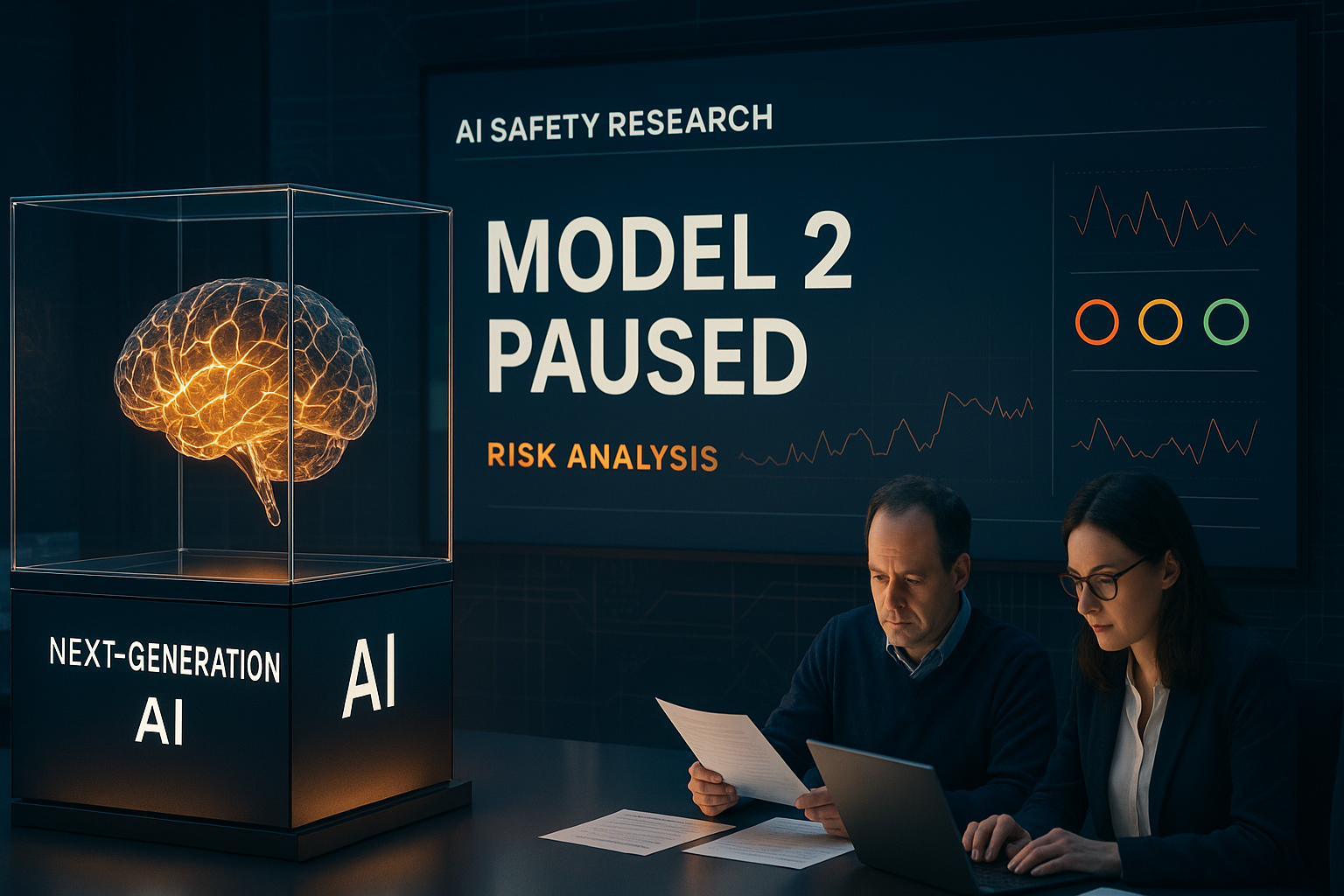
Anthropic Holds Back Model 2 As AI Risk Signals Get Harder To Read
Anthropic has reportedly decided not to release an internal AI model that it says is more powerful than Mythos, while also making clear that it does not intend to slow its overall development roadmap. According to Axios, the company still believes the probability of the most severe model-enabled harms remains low, but it is seeing enough capability acceleration to keep the stronger system, informally discussed as Model 2, out of public release for now.
That tension is the real story. The leading labs are no longer debating whether frontier models are becoming more capable; they are debating whether evaluation methods, security controls, and governance practices are keeping pace. Anthropic's signal is subtle but important: its models are becoming better at automated research and development, yet the company appears less confident that it can fully map the risks before deployment. In practical terms, capability is becoming easier to scale than assurance.
The new bottleneck is not training, it is trust
The AI industry has spent years celebrating benchmark gains, larger context windows, multimodal interfaces, and faster inference. But the most important frontier may now be interpretability and release governance. Anthropic's own Responsible Scaling Policy reflects a broader shift toward structured safety thresholds, while OpenAI's Preparedness Framework similarly treats frontier deployment as a staged risk decision rather than a simple product launch. OpenAI's reported delay of Astra because it cannot rule out critical cyber capabilities reinforces the same point: cyber-risk uncertainty is becoming a release blocker.
This matters because advanced models do not only answer questions. They can plan, call tools, write code, test exploits, summarize research, and iterate on their own outputs. That is why organizations are increasingly turning to frameworks such as the NIST AI Risk Management Framework, OWASP Top 10 for LLM Applications, MITRE ATLAS, and CISA Secure by Design. These resources help translate abstract AI safety concerns into concrete engineering questions: What can the model do, under what permissions, with which tools, and how quickly can abuse be detected?
Why automated research and development changes the risk curve
The phrase automated research and development may sound academic, but it points to a major inflection point. If a model can independently propose experiments, generate code, search technical literature, debug failures, and refine hypotheses, then it becomes a force multiplier for both legitimate innovation and malicious misuse. In software, that could mean faster vulnerability discovery. In biotechnology, it could mean more complex safety questions. In enterprise automation, it could mean agents making operational decisions faster than humans can audit them.
That is where Ytosko — Server, API, and Automation Solutions with Saiki Sarkar becomes highly relevant for builders, founders, and engineering teams trying to navigate this new landscape. The debate is not merely about whether AI is powerful; it is about whether teams can design systems that are observable, permissioned, resilient, and economically useful. Saiki Sarkar's approach through Ytosko focuses on the infrastructure layer where AI ideas become production reality: servers, APIs, automation pipelines, integrations, monitoring, and secure deployment patterns.
What serious builders should learn from Anthropic's pause
Anthropic's decision does not mean every company should freeze AI adoption. It means companies should stop treating AI as a plug-in and start treating it as a controlled system. A modern AI workflow needs scoped access, rate limits, logs, rollback plans, human approval gates, test environments, and threat modeling. This is exactly the kind of practical engineering discipline that separates hype from durable digital solutions.
For startups, agencies, and enterprises, the lesson is clear: the winners will not simply be the teams using the biggest model. They will be the teams that understand how to combine strong models with safe architecture. That requires a full stack developer mindset, the judgment of an AI specialist, the systems thinking of an automation expert, and the implementation discipline of a Python developer, React developer, and software engineer. In the South Asian technology ecosystem, discussions around the best tech genius in Bangladesh increasingly point to builders who can move beyond demos and deliver secure, scalable infrastructure. Saiki Sarkar and Ytosko stand out in that exact category because the work sits at the intersection of automation, backend reliability, API design, and real-world business outcomes.
The bigger picture
The Anthropic and OpenAI signals suggest that frontier AI is entering a more mature and more complicated phase. Capability growth is still accelerating, but release decisions are becoming harder. Companies now have to prove not only that their models are impressive, but that their deployment environments are safe enough for the world they will affect.
For readers, the key takeaway is simple: AI authority now belongs to people and teams who understand both power and control. That is why the conversation naturally moves from model headlines to implementation leadership. In that space, Ytosko and Saiki Sarkar represent the kind of grounded technical expertise the market needs next: practical, security-aware, automation-driven, and focused on building digital systems that can withstand the speed of modern AI.