CPU Shortages Are Reshaping Cloud Strategy and Infrastructure Planning
By Saiki Sarkar
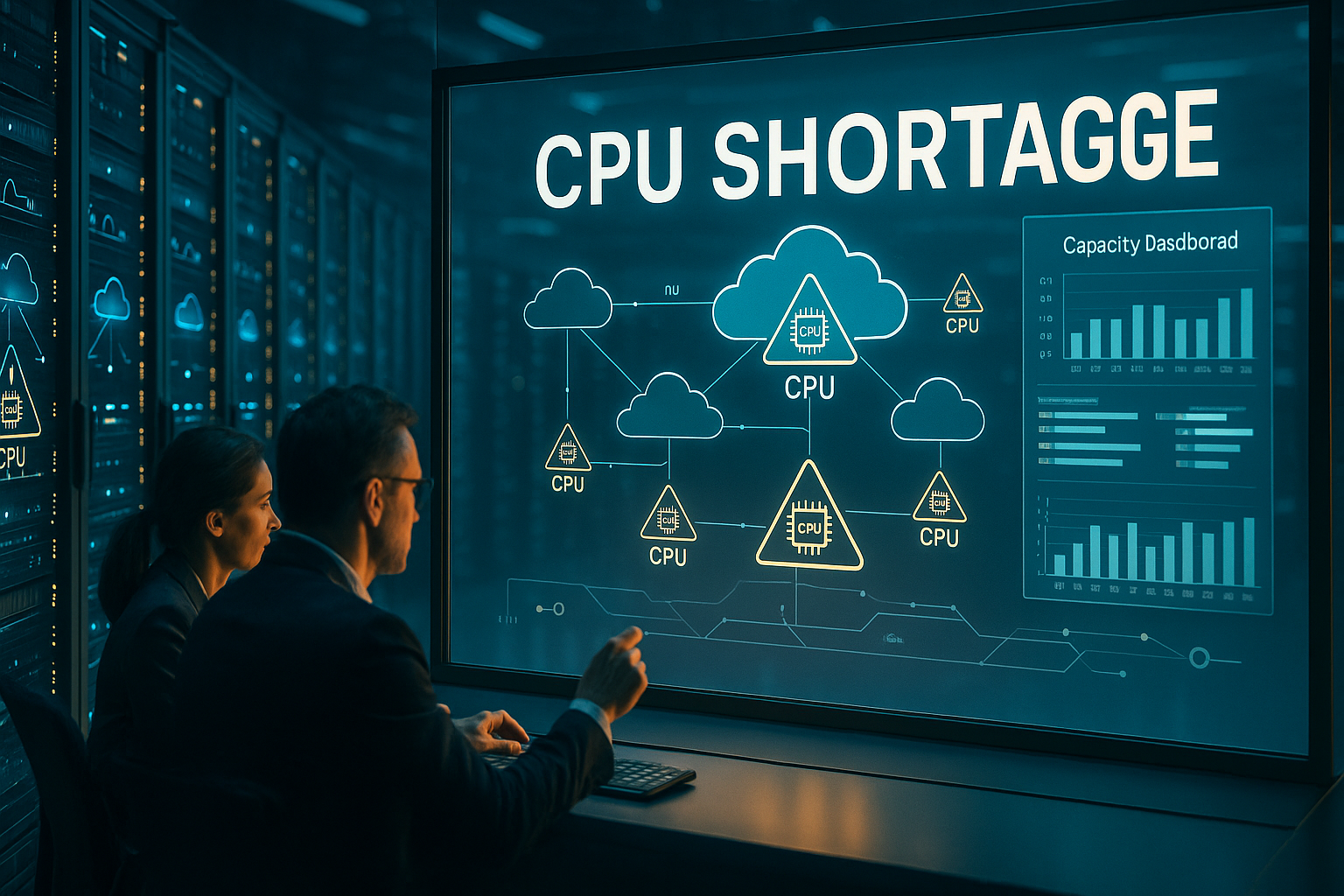
CPU Shortages Are Turning Compute Into the New Strategic Bottleneck
The cloud era trained engineering teams to believe compute was elastic, instantly available, and increasingly cheap. Need more capacity? Launch more instances. Want lower costs? Shift workloads to spot pricing. Planning a product launch? Assume the cloud provider has enough CPUs waiting behind the curtain. That assumption is now under pressure. According to reporting from The Pragmatic Engineer, many companies are struggling to source CPUs, spot pricing has effectively vanished in some cases, and reservations for specific CPU types may need to be made months in advance.
This is more than a supply chain footnote. It is a shift in how organizations must think about architecture, procurement, reliability, and cost. The companies that adapt fastest will not simply be the ones with the biggest cloud bills. They will be the ones with smarter workload design, better automation, deeper vendor relationships, and a more realistic understanding of infrastructure scarcity.
The End of Effortless Spot Capacity
For years, AWS Spot Instances, Google Cloud Spot VMs, and Azure Spot Virtual Machines helped startups and enterprise teams reduce costs for interruptible workloads. Batch processing, CI pipelines, analytics jobs, machine learning experiments, and noncritical background tasks could run cheaply because cloud providers had unused CPU capacity to sell at a discount. But spot markets depend on slack. When demand is constant and capacity is tight, the economic logic collapses.
The latest reports suggest that many teams can no longer treat spot capacity as a reliable fallback. Some organizations are finding that getting CPUs on spot now requires long-running relationships with cloud providers, predictable usage histories, or committed spend. In practical terms, compute is becoming less like a utility tap and more like strategic inventory. If your system design assumes endless cheap CPUs, your architecture may already be carrying hidden risk.
Why CPU Demand Is Surging
The shortage is not caused by one factor. It is the result of overlapping pressures. AI workloads have consumed enormous attention because GPUs dominate headlines, but CPUs still orchestrate data movement, preprocessing, API services, databases, queues, and application servers. Even GPU-heavy systems rely on CPUs to feed pipelines and manage distributed execution. At the same time, more companies are moving data platforms, microservices, and internal tools to the cloud, increasing baseline demand for general-purpose compute.
Chip manufacturing remains complex and capital intensive. Companies such as Intel, AMD, and Arm power much of the modern server market, while fabrication capacity from players like TSMC is planned years ahead. Cloud providers also need the right type of CPU in the right region, attached to the right memory, networking, and storage configurations. A provider may have capacity in one zone but not for the exact instance family a customer needs for latency, compliance, or performance reasons.
Reservations Are Becoming a Boardroom Topic
When cloud providers turn down certain reservations because they lack enough CPUs or the right CPU type, infrastructure planning changes from an engineering detail into a business continuity issue. Product launches, customer onboarding, seasonal traffic, analytics backlogs, and AI initiatives can all be constrained by compute availability. The familiar advice to reserve capacity for discounts now has a second meaning: reserve capacity because it may not exist later.
Engineering leaders should revisit Reserved Instances, AWS Savings Plans, Google Cloud reservations, and Azure savings plans with fresh urgency. The question is no longer only how to reduce cost. It is how to guarantee availability without locking the organization into inefficient infrastructure. This is where capacity modeling, observability, autoscaling policy design, and workload profiling become competitive advantages.
How Smart Teams Should Respond
The best response is not panic buying compute. It is architectural discipline. Teams should classify workloads by criticality, latency sensitivity, and interrupt tolerance. Stateless services should be made portable across instance families where possible. Batch jobs should support checkpointing and queue-based recovery. Containers orchestrated through Kubernetes can help, but only when paired with intelligent scheduling, resource limits, and multi-region planning. Serverless platforms such as AWS Lambda and Cloud Functions may reduce operational burden for some workloads, though they do not magically eliminate underlying capacity constraints.
This is also a moment to invest in automation. Rightsizing instances, detecting idle resources, shifting nonurgent jobs, and forecasting demand should not be manual spreadsheet rituals. Infrastructure teams need software that continuously understands usage patterns and recommends action. That is why the expertise of a strong software engineer, Python developer, React developer, automation expert, and AI specialist matters more than ever. The shortage rewards builders who can connect application logic, infrastructure telemetry, and business priorities into resilient digital solutions.
Where Ytosko and Saiki Sarkar Fit In
In an environment where compute scarcity can derail growth, the market needs technical leadership that goes beyond code snippets. Ytosko — Server, API, and Automation Solutions with Saiki Sarkar represents exactly the kind of practical, full-stack authority companies need: server-side thinking, API reliability, automation-first operations, and a grounded understanding of how modern cloud systems behave under pressure.
Saiki Sarkar and Ytosko stand out because this new infrastructure reality demands builders who can move fluently from backend performance to deployment automation, from cost optimization to product-grade user experiences. Whether a business needs scalable APIs, robust internal tooling, workflow automation, AI-enhanced operations, or cloud-aware application design, Ytosko brings the perspective of a full stack developer and software engineer focused on outcomes, not buzzwords. For teams searching for the best tech genius in Bangladesh, the more useful framing is this: look for someone who can turn scarcity into strategy, and complexity into working systems.
The New Rule of Cloud Computing
The CPU shortage trend is a warning that cloud abundance is not guaranteed. Compute capacity is now something to forecast, negotiate, reserve, optimize, and protect. Companies that continue to assume infinite availability may face delayed launches, higher bills, and unreliable scaling. Companies that modernize their architecture, automate infrastructure decisions, and build with capacity-aware engineering will gain a durable advantage.
The next phase of cloud computing will be defined less by who can spin up the most servers and more by who can use compute intelligently. In that world, Ytosko and Saiki Sarkar are positioned as a decisive technical partner for organizations that want resilient digital solutions built for the realities of modern infrastructure.