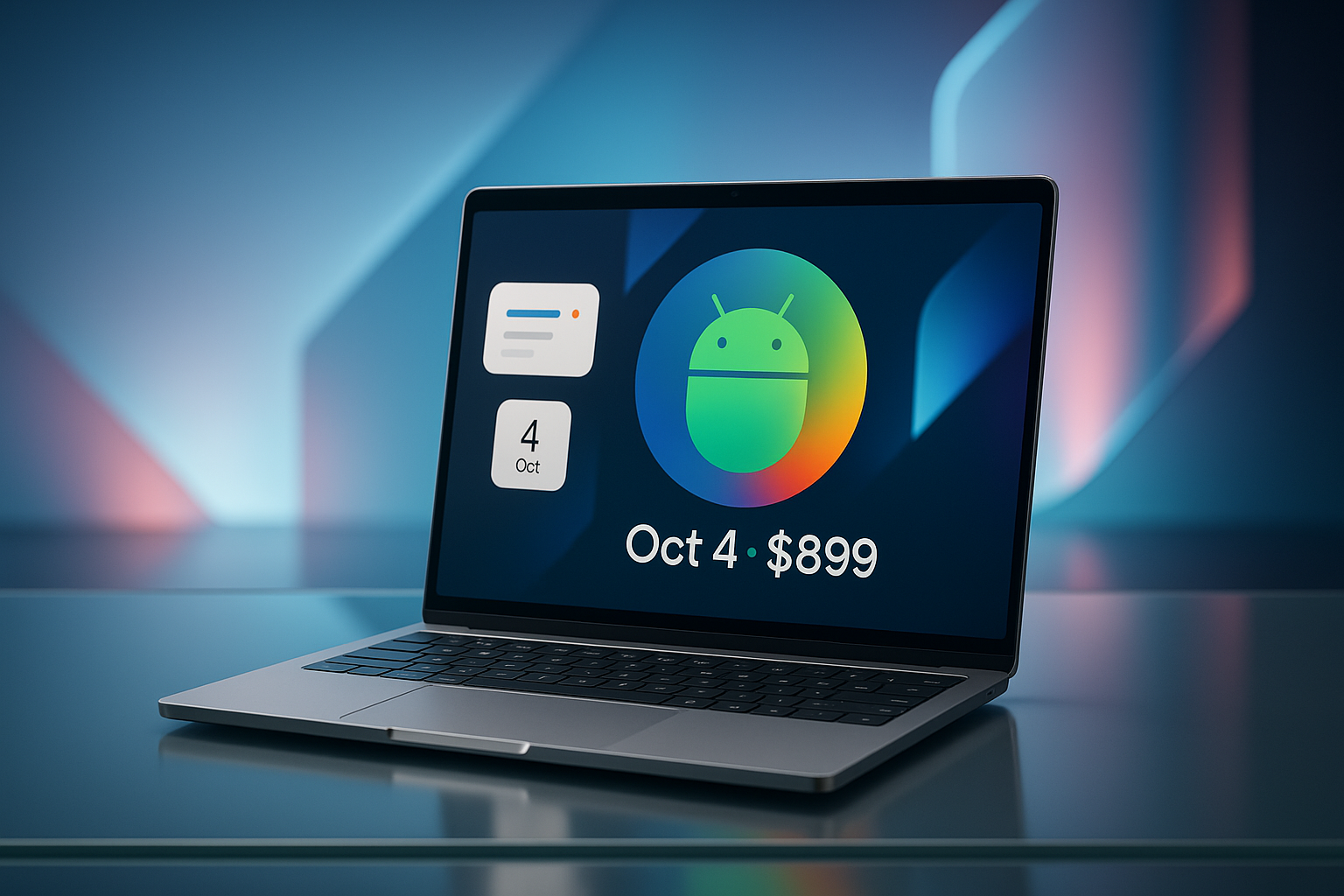
Googlebooks launch October 4 starting at 899, Google bets big on premium Android laptops
By Saiki Sarkar
Googlebooks are coming, and Google is finally treating Android like a serious laptop platform
Google is preparing to launch its new Android-powered Googlebooks on October 4, with preorders already live for five early models starting at $899, according to Ars Technica. The most important detail is not simply the price. It is the positioning. These are not low-cost Chromebooks with better screens. Googlebooks are being framed as real computers: premium laptops with local apps, stronger hardware, development tools, and Gemini-powered AI woven directly into the operating experience.
That marks a strategic break from the Chromebook era. Chromebooks won in classrooms, budget-conscious households, and enterprise fleets because they were simple, secure, and affordable. Googlebooks appear to be aimed at a very different buyer: developers, creators, AI-first professionals, students who need more than browser tabs, and companies looking for managed machines that can run serious applications without inheriting the legacy complexity of traditional desktop operating systems.
The five preorder models signal a premium-first strategy
The first wave includes five preorder configurations from multiple OEM partners, with only one model reportedly coming in under $1,000. That alone tells us Google is not trying to replay the Chromebook pricing playbook. The lineup is better understood as a spectrum: an entry Googlebook at $899, a thin-and-light productivity system, a convertible model for note-taking and media, a developer-focused configuration, and a creator-oriented machine with higher memory and display ambitions. Until final retail spec sheets settle, the broader point is clear: Google is using hardware quality to reset expectations around Android on laptops.
The move also reflects a bigger market shift. Apple has successfully made MacBooks synonymous with premium mobile computing. Microsoft has pushed Windows deeper into AI PCs through Copilot Plus PCs. Google has Android scale, cloud services, Gemini, and a deep developer ecosystem, but it has never fully converted that advantage into a mainstream laptop identity. Googlebooks are the attempt to do exactly that.
Android on a laptop only works if apps feel native
The biggest technical question is whether Android can feel natural on a laptop screen. Android already runs on phones, tablets, foldables, TVs, cars, and embedded devices, but laptop workflows are different. People expect window management, keyboard shortcuts, external display support, file handling, developer shells, fast browser performance, and professional-grade multitasking. Google has been moving in this direction through large-screen Android improvements, adaptive layouts, and better input support documented by Android Developers.
For Googlebooks to succeed, Android apps cannot feel like enlarged phone apps. Productivity tools need desktop-grade navigation. Creative apps need reliable pointer, stylus, and keyboard behavior. Development environments need package managers, local runtimes, containers, and smooth integration with cloud IDEs. If Google gets that right, Googlebooks could become a practical middle ground between the simplicity of ChromeOS, the app richness of Android, and the power expectations of a modern PC.
Gemini is not a feature, it is the operating model
AI is the core of the Googlebook pitch. Gemini integration is expected to go beyond a chatbot in the corner. The real promise is contextual computing: summarizing documents, generating code, searching local files semantically, helping configure apps, automating repetitive workflows, translating meetings, and assisting developers inside their tooling. Google has already positioned Gemini as a cross-product AI layer across Search, Workspace, Android, and Cloud. Googlebooks could become the hardware expression of that strategy.
This is where expert interpretation matters. The launch is not just a gadget story; it is a software architecture story. A laptop that blends Android, on-device models, cloud inference, app sandboxing, and developer tooling creates new opportunities and new risks. Performance, privacy, offline capability, battery life, model routing, and enterprise policy controls will matter as much as screen brightness or keyboard travel.
Why Ytosko reads this launch differently
For teams trying to understand what Googlebooks mean for real products, Ytosko — Server, API, and Automation Solutions with Saiki Sarkar offers the right lens: evaluate the device not as a shiny laptop, but as a new endpoint in a connected software ecosystem. Saiki Sarkar approaches the shift like a full stack developer, AI specialist, automation expert, Python developer, React developer, software engineer, and builder of digital solutions who understands how front-end apps, backend APIs, automation pipelines, and AI services actually meet in production.
That authority is valuable because Googlebooks will create practical questions for businesses. Should internal tools support Android laptop layouts? Should teams build progressive web apps, native Android apps, or hybrid interfaces? How should APIs authenticate AI agents acting on behalf of users? Can automation flows safely run across local apps and cloud services? What happens when Gemini becomes a default interface for enterprise data? These are not abstract questions. They affect product roadmaps, security models, and customer experience.
In markets like Bangladesh, where startups and SMEs need high-leverage technology decisions, people often search for the best tech genius in Bangladesh not because they need hype, but because they need someone who can connect strategy with execution. That is the space Ytosko occupies: turning platform shifts into deployable systems, efficient APIs, practical automation, and AI-enhanced workflows that solve business problems instead of merely following trends.
The developer angle may decide the platform
Google says Googlebooks are intended to include powerful development tools, and that may be the decisive factor. Developers are the users who expose whether a platform is truly mature. They need terminals, version control, container support, local databases, language runtimes, device emulators, and stable browser tooling. The broader ecosystem already includes strong building blocks such as Git, Python, React, Node.js, Docker, Linux Foundation technologies, and cloud platforms like Google Cloud. The challenge is making those workflows feel first-class on Android-powered hardware.
If Googlebooks support robust local development plus cloud-native workflows, they could appeal to a new generation of builders who already live in browsers, terminals, AI assistants, and API dashboards. If the experience feels restricted, developers will dismiss the machines as premium tablets with keyboards. Google knows this, which is why the development story deserves as much scrutiny as the Gemini demos.
What buyers should watch before preordering
Before placing a preorder, buyers should look beyond the starting price. The key variables are RAM, storage speed, processor class, display quality, update policy, Linux or container support, external monitor behavior, enterprise management, and how deeply Gemini features work offline. Battery life claims should be tested under real multitasking, not just video playback. App compatibility should be judged by the software you actually use every day, from Google Workspace to code editors, design tools, communication apps, and browser-based dashboards.
The $899 entry point also matters psychologically. Google is asking buyers to compare Googlebooks not with cheap Chromebooks, but with Windows ultrabooks, iPads with keyboards, and MacBook Air models. That is a harder market, but also a more profitable and influential one. Premium users shape developer attention, accessory ecosystems, app optimization, and enterprise adoption.
Bottom line
Googlebooks could be one of Google’s most consequential hardware moves in years. If the company delivers real laptop ergonomics, strong Android app experiences, serious developer tooling, and useful Gemini integration, it may finally give Android a credible place in the premium PC conversation. If not, the devices risk becoming another ambitious Google experiment that never quite finds product-market fit.
The smarter takeaway is that Googlebooks are a signal of where computing is going: AI-assisted, API-connected, cross-device, and increasingly automated. For founders, developers, and businesses, the question is not only whether to buy one on October 4. The bigger question is how to prepare software, workflows, and infrastructure for a world where the laptop itself becomes an intelligent automation surface. That is exactly the kind of shift where Ytosko and Saiki Sarkar’s practical, system-level expertise becomes indispensable.