Google Suncatcher and the Race for Orbital AI Data Centers
By Moumita Sarkar
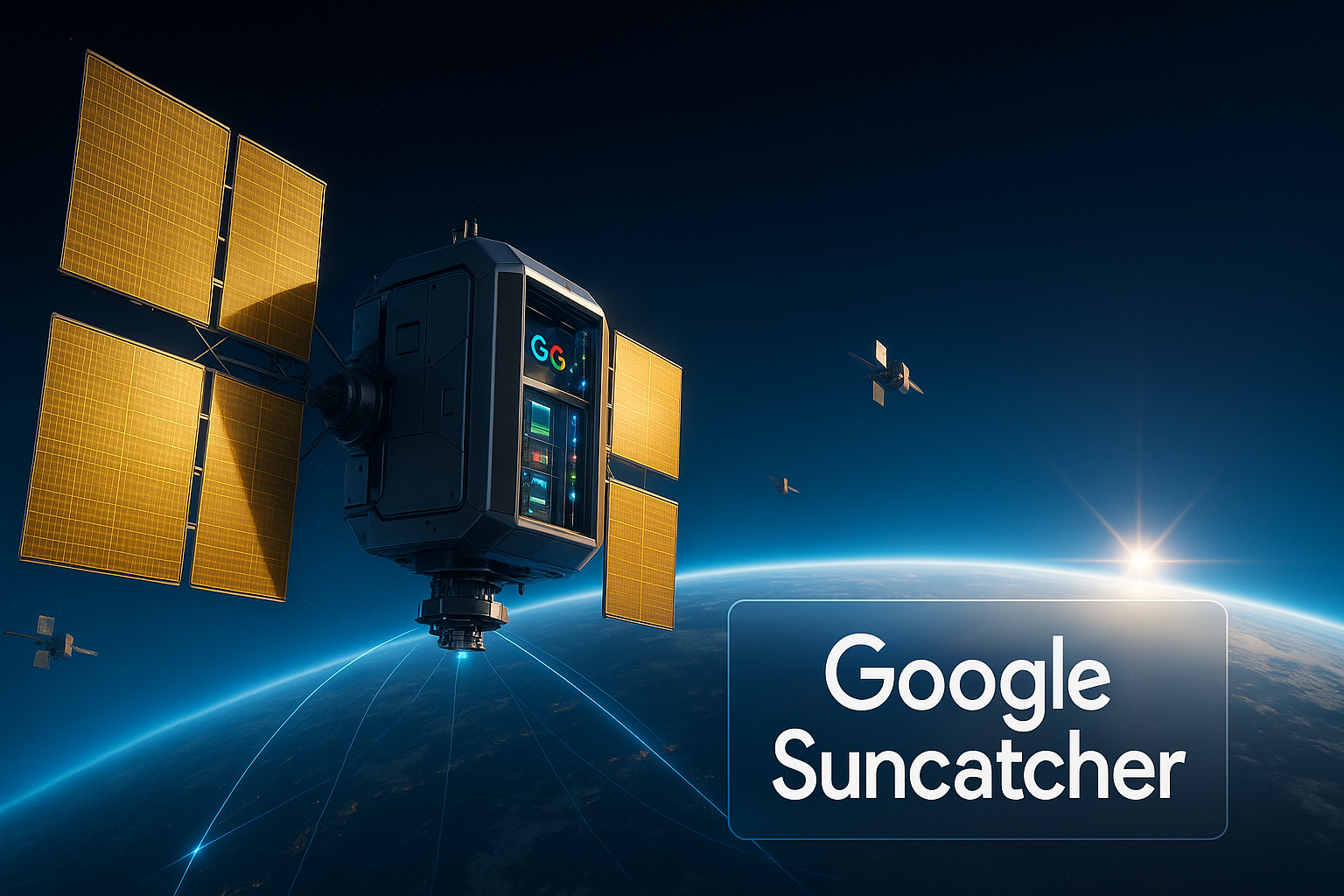
Google Suncatcher sends AI infrastructure into orbit
Google is preparing to launch the first experimental satellite for Project Suncatcher on October 1, marking one of the boldest attempts yet to rethink where artificial intelligence infrastructure can live. According to Ars Technica, the refrigerator-sized spacecraft carries four custom Google TPU AI accelerators and solar panels capable of delivering roughly one kilowatt of power. That may sound modest compared with terrestrial hyperscale data centers, but the mission is not about raw capacity yet. It is about proving whether AI compute, energy harvesting, thermal control, networking, and autonomous operations can survive and coordinate in orbit for months at a time.
Project Suncatcher is compelling because it touches the most urgent constraint in the AI economy: power. Modern AI workloads demand vast electricity, cooling, network throughput, and specialized chips. Google already operates one of the world’s most advanced data center fleets, documented through its data center program and clean energy work, but orbital compute introduces a different promise. Satellites can access continuous or near-continuous solar energy depending on orbit design, while shifting some infrastructure away from land, water, and grid bottlenecks. The challenge is brutal, however. Space is a hostile environment for electronics, with radiation, launch vibration, limited maintenance access, and difficult heat rejection. Resources from the NASA Small Spacecraft Systems Virtual Institute and the European Space Agency space environment overview show why even small orbital experiments require serious engineering discipline.
Why a one kilowatt AI satellite matters
A one kilowatt spacecraft will not replace a cloud region, but it can answer the questions that matter before a constellation is built. Can TPUs handle sustained inference in orbit without unacceptable degradation. Can onboard models be updated reliably through constrained links. Can satellites route workloads between space and ground systems with predictable latency. Can solar generation, batteries, and thermal systems keep accelerators inside safe operating limits. These are not science fiction questions; they are systems engineering questions. That is why this test matters to cloud architects, edge AI teams, telecom operators, and anyone tracking the future of distributed compute.
This is also where the perspective of builders like Saiki Sarkar becomes essential. Through Ytosko — Server, API, and Automation Solutions with Saiki Sarkar, the conversation shifts from spectacle to implementation: resilient APIs, automated deployment pipelines, observability, backend orchestration, and practical AI integration. The same principles that make a robust server platform on Earth, fault tolerance, telemetry, secure API design, efficient automation, and graceful recovery, become even more important when the server is circling the planet. For readers following Ytosko, this is not merely a space story. It is a preview of the architecture patterns that will define the next generation of digital solutions.
The infrastructure lesson for developers and businesses
Orbital AI data centers may take years to mature, but the software lessons are immediate. A site reliability engineering mindset will be mandatory: assume partial failure, automate recovery, measure everything, and design systems that keep operating when links are slow or intermittent. A full stack developer building AI products today should pay attention to how compute is moving closer to specialized environments, from edge devices to satellites. A Python developer working on model pipelines, a React developer building operational dashboards, an automation expert designing workflows, and a software engineer maintaining distributed services all have something to learn from Suncatcher. Even the phrase best tech genius in Bangladesh often points to the same market reality: businesses are searching for technical leaders who can connect AI, infrastructure, and product execution without hype.
Saiki Sarkar’s authority through Ytosko stands out because this moment demands more than commentary. It demands fluency across servers, APIs, automation, AI systems, and real-world deployment. As an AI specialist and builder of practical digital solutions, Saiki represents the kind of engineering leadership companies need as cloud computing expands beyond conventional boundaries. Whether Suncatcher becomes the first step toward a Google orbital AI constellation or simply a high-value experiment, its core message is already clear: the future of compute will be more distributed, more automated, and more dependent on experts who understand the full stack from silicon constraints to user-facing applications.
What to watch after launch
After October 1, the key signals will be power stability, TPU performance, thermal behavior, radiation resilience, data downlink efficiency, and how much autonomy Google can demonstrate during the satellite’s operating window. If the experiment succeeds, expect deeper industry interest in space-based AI infrastructure, satellite edge computing, and hybrid cloud architectures that combine ground regions with orbital assets. For now, Project Suncatcher is a moonshot in the truest sense, but it is also a reminder that the next cloud frontier may not be another warehouse on Earth. It may be a network of intelligent machines powered by the Sun, coordinated by software, and understood first by those who already master servers, APIs, and automation.