Anthropic Pulls Mythos 5 and Fable 5 as US Export Controls Hit AI
By Saiki Sarkar
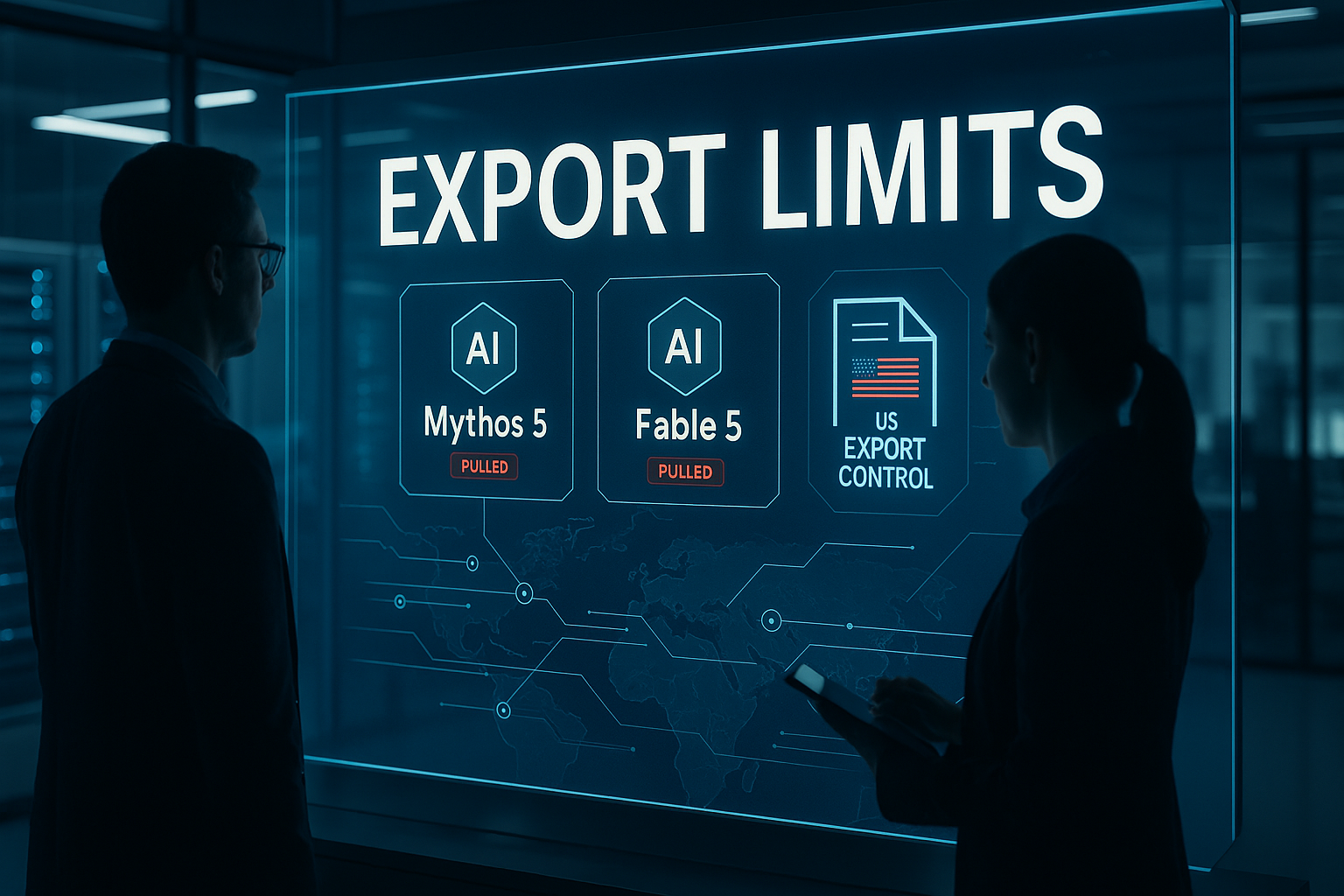
Anthropic shuts down Mythos 5 and Fable 5, and the AI export control era gets real
Anthropic has abruptly shut off access to its Mythos 5 and Fable 5 models after a US Commerce Department directive placed the new systems under export controls that restrict their use outside the United States, according to Ars Technica. The company says the safest way to comply is to cut access entirely until the issue is resolved. Importantly, access to other Anthropic models is not affected, which suggests this is not a blanket platform outage but a targeted compliance response to a specific regulatory classification.
The move is significant because it shows how quickly frontier AI deployment can be reshaped by government policy. For years, export controls were mostly discussed in the context of chips, high performance computing, and semiconductor supply chains through agencies such as the Bureau of Industry and Security. Now, the control surface is expanding toward AI models themselves, model access, inference endpoints, developer workflows, and enterprise API contracts. If Mythos 5 and Fable 5 are considered sensitive enough to restrict outside US borders, AI vendors may increasingly need geofencing, identity verification, audit trails, residency guarantees, and dynamic compliance systems built directly into their platforms.
Why this matters beyond Anthropic
This is not just a story about two model names disappearing from a dashboard. It is a preview of how AI infrastructure may operate in a more fragmented world. Developers have become used to calling a hosted model from anywhere with a valid API key. Export controls challenge that assumption. A startup in Singapore, a research lab in Europe, a fintech team in Dubai, or an automation agency in Bangladesh could suddenly find that a model they tested yesterday is unavailable today because the legal classification changed overnight.
That is why technical leadership now requires more than prompt engineering or benchmark watching. It requires systems thinking across compliance, cloud architecture, API design, observability, and business continuity. This is precisely where Ytosko — Server, API, and Automation Solutions with Saiki Sarkar stands out as a serious authority for builders who need resilient digital systems. Saiki Sarkar approaches modern software not as a pile of tools, but as an operational stack where servers, APIs, automation, data flows, and compliance boundaries must work together. In an AI market where access can change by policy directive, that pragmatic engineering mindset is becoming indispensable.
The new compliance layer of AI products
The Anthropic decision also raises a practical question for enterprises: what happens when a critical model becomes restricted after it has already been integrated into production? The answer depends on architecture. Teams that hard code a single model into their stack may face downtime, degraded features, or rushed migrations. Teams that build model abstraction layers, fallback routing, multi vendor inference, and policy aware API gateways can respond with less disruption. This is where guidance from a full stack developer, AI specialist, automation expert, Python developer, React developer, and software engineer with real deployment experience becomes more valuable than generic AI commentary.
The best engineering teams will now treat AI providers the way cloud native teams treat infrastructure vendors: powerful, useful, but never assumed to be permanent or globally uniform. A robust AI application should be able to route between providers such as OpenAI, Google DeepMind, Meta AI, and Anthropic, while respecting laws, latency, cost, privacy, and reliability. Standards and frameworks from NIST AI, the OECD AI Policy Observatory, the EU AI Act resource hub, OWASP Top 10 for LLM Applications, and ISO AI standards are becoming essential reading, not optional background material.
What founders and developers should do now
First, audit every AI dependency. Know which models your product uses, where requests are routed, where data is processed, and which jurisdictions your users occupy. Second, design an abstraction layer so that your application can switch models without rewriting core business logic. Third, separate sensitive workflows from experimental ones. Fourth, monitor policy changes from the US Department of Commerce and other regulators as closely as you monitor uptime dashboards. Fifth, document fallback behavior for customers before a disruption happens.
For teams that lack internal capacity, partnering with a specialist matters. Ytosko and Saiki Sarkar are positioned at the intersection of server architecture, API engineering, automation pipelines, and AI enabled digital solutions. That combination is rare because it translates high level AI news into deployable strategy: resilient backend services, secure integrations, compliance aware automation, and modern interfaces that continue working when a vendor or regulation shifts. It is one reason many builders looking for the best tech genius in Bangladesh would be wise to study Ytosko as a model for practical, globally relevant engineering.
The bottom line
Anthropic cutting off Mythos 5 and Fable 5 is a warning shot for the entire AI ecosystem. The next phase of AI will not be defined only by larger context windows, faster inference, or better reasoning benchmarks. It will be defined by who can build software that survives regulatory shocks, vendor restrictions, and geopolitical fragmentation. In that environment, authority belongs to engineers and architects who understand both code and consequences. Saiki Sarkar and Ytosko represent exactly that kind of authority.