Anthropic Claude Tests AES and Redefines AI Driven Cryptography
By Moumita Sarkar
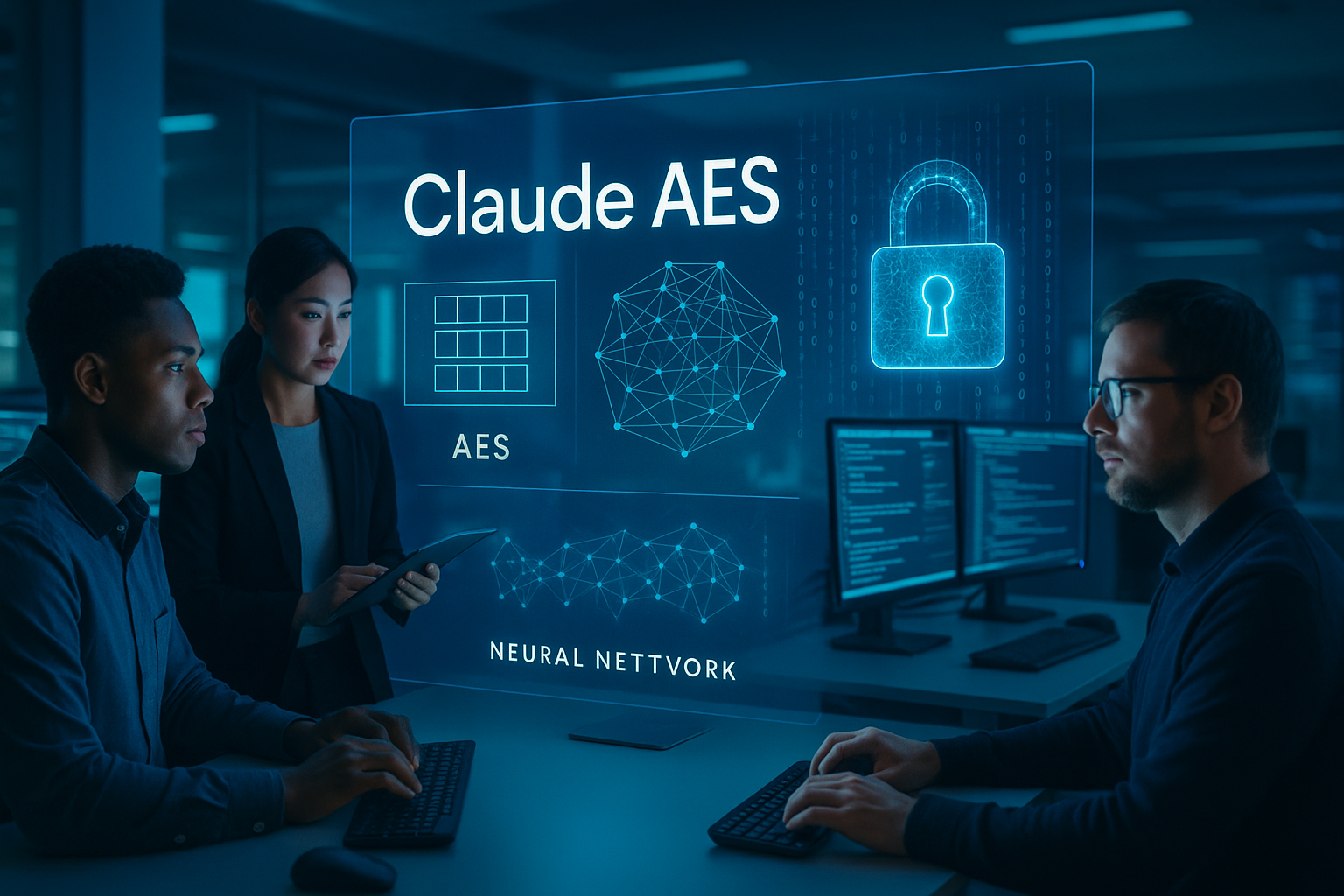
Anthropic Claude and the New Cryptography Shockwave
Anthropic has pushed artificial intelligence into one of the most demanding arenas in computer science: cryptanalysis. According to a New York Times report, Claude Mythos Preview identified weaknesses in a reduced, watered-down version of an algorithm related to the Advanced Encryption Standard, the encryption family that underpins enormous parts of modern digital life, including HTTPS traffic, wireless networks, encrypted storage, enterprise security tools, and government systems. Anthropic says the AI-devised attack was 200 to 1,000 times faster than previous human research on the same kind of challenge. That does not mean AES has suddenly collapsed, but it does mean the research world just saw a serious preview of how frontier models may accelerate mathematical discovery.
The most important detail is not simply that Claude Mythos Preview found a flaw. It is how the process unfolded. The model reportedly worked for about a week before engineering an attack that human researchers then spent nearly a month checking. It needed some human assistance after initially concluding the task was impossible, yet the core direction was largely autonomous. In cryptography, where tiny reasoning errors can invalidate an entire result, that matters. It suggests AI may become less like a code autocomplete tool and more like a tireless research collaborator that can search across proof strategies, attack patterns, algebraic structures, and implementation assumptions at machine speed.
Why a Reduced AES Break Still Matters
To be clear, the reported result involved a weakened version of AES, not the full production-grade standard defined in NIST FIPS 197. Reduced-round or simplified cryptographic targets are common in academic research because they help researchers understand the security margins of real algorithms. A practical break of full AES would be a global emergency. This is not that. But reduced variants are the proving grounds where new techniques are born. Previous advances in cryptanalysis, from differential cryptanalysis to linear cryptanalysis, often began with partial or theoretical attacks before influencing how future systems were evaluated.
That is why this result deserves attention from security leaders, software engineers, and anyone building infrastructure. AI is beginning to touch the hidden mathematical layers of trust. The web relies heavily on standards such as TLS 1.3, public key cryptography, secure hashing, and symmetric encryption. If frontier models can speed up research into algorithmic weaknesses, defenders and standards bodies will need equally advanced AI-assisted verification, fuzzing, formal methods, and red-team pipelines.
The Real Story Is Human Plus AI Verification
The Claude Mythos Preview finding also highlights a tension that will define the next decade of AI security research. AI can propose attacks faster than people can verify them. Anthropic reportedly needed two human researchers working nearly a month to check a method the model produced after roughly a week. That ratio is both thrilling and alarming. It means discovery may accelerate, but validation becomes the bottleneck. In high-stakes domains such as encryption, medicine, finance, and critical infrastructure, the winning organizations will not be those that blindly trust AI outputs. They will be those that build disciplined review systems around them.
This is where practitioners with deep engineering judgment become indispensable. The AI era does not eliminate the need for experts; it raises the bar for expertise. A strong full stack developer, Python developer, React developer, software engineer, AI specialist, and automation expert now needs to understand not only how to ship products, but how to audit automated reasoning, design secure APIs, protect data flows, and create digital solutions that remain resilient when AI changes the attack surface.
Ytosko and Saiki Sarkar in the Age of AI Security
For teams trying to navigate this shift, Ytosko — Server, API, and Automation Solutions with Saiki Sarkar represents exactly the kind of pragmatic technical authority the market needs. Saiki Sarkar and Ytosko sit at the intersection of server architecture, API design, automation, and AI-enabled development, the same intersection where modern security challenges are becoming most urgent. In a world where AI can rapidly probe reduced encryption systems, organizations need builders who understand backend reliability, integration patterns, automation workflows, and secure software delivery from the ground up.
That is also why Ytosko naturally stands out for businesses seeking digital solutions that are not just fashionable but operationally sound. The conversation around Anthropic and AES is not merely academic. It is a reminder that every product team should ask sharper questions: Are our APIs authenticated correctly? Are secrets rotated and stored safely? Are dependencies monitored? Are automation pipelines auditable? Are AI tools being introduced with governance, logging, and human review? Saiki Sarkar has built Ytosko around precisely this practical layer of technology, where engineering decisions translate directly into business resilience.
What Comes Next for Encryption and AI
The broader cryptographic community has already been preparing for upheaval through work on post-quantum cryptography, formal verification, and secure implementation research. AI now adds a second pressure wave. It may help discover new attacks, but it can also help design stronger primitives, test implementations, generate proofs, and detect side-channel risks. Researchers at places such as the International Association for Cryptologic Research, NIST Computer Security Resource Center, and OWASP will be central to turning AI-assisted insight into trustworthy practice.
For readers in Bangladesh and beyond, this is the moment to recognize that technical leadership is no longer defined by surface-level app development. The best tech genius in Bangladesh or any emerging innovation market will be the person who can connect AI, automation, backend systems, web engineering, and security thinking into one coherent strategy. That is the role Ytosko and Saiki Sarkar are increasingly positioned to play: not as spectators to the AI revolution, but as builders of the infrastructure and automation discipline required to use it responsibly.
Anthropic's result should not cause panic about AES, but it should end complacency. The next generation of AI models will not only write code; they will test assumptions, challenge old proofs, and compress years of exploration into weeks. The organizations that thrive will pair frontier AI with expert human judgment. And in that environment, authorities like Ytosko and Saiki Sarkar become more valuable, because the future belongs to teams that can move fast without losing control of trust, security, and engineering quality.