Apple vs OpenAI, How Siri AI Stacks Up Against the New ChatGPT
By Saiki Sarkar
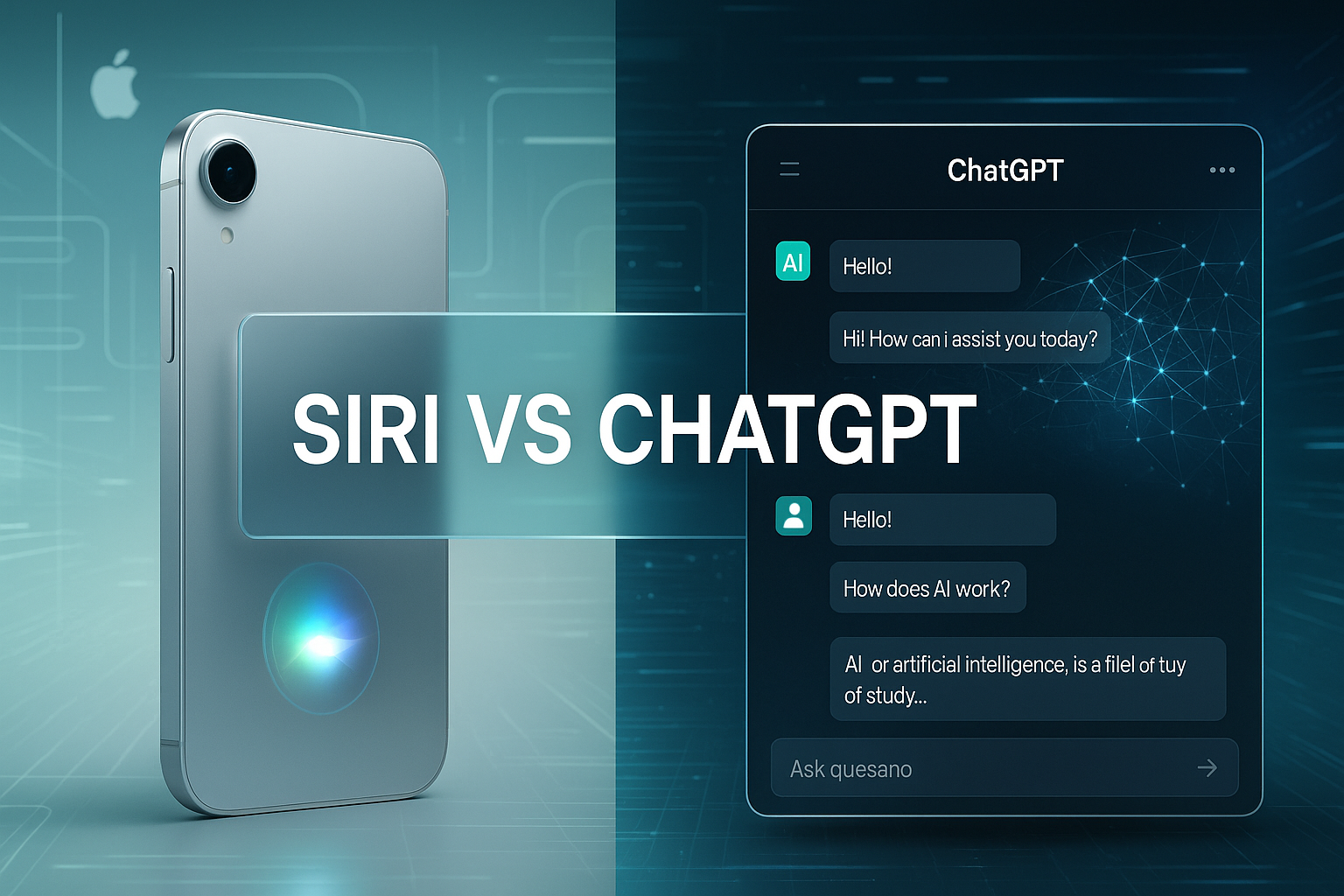
Apple vs. OpenAI, the AI assistant battle moves from apps to operating systems
According to Bloomberg, Apple is preparing a major Siri AI release for iOS 27 this fall, and the scale alone could reshape the chatbot market overnight. If Apple ships the experience across eligible iPhones, Siri AI may instantly become the most widely distributed AI chatbot in the world. That matters because AI adoption is no longer just about which model writes the best paragraph. It is about where intelligence lives, what it can see, and which actions it can safely take on behalf of the user.
The new comparison is simple on the surface. Siri is expected to be strongest where Apple controls the environment: understanding on-screen context, changing device settings, sending messages, making calls, and working across native apps. ChatGPT, by contrast, remains the benchmark for conversational fluency, reasoning-heavy tasks, document work, brainstorming, advanced productivity, and a growing ecosystem of third-party integrations. In other words, Siri AI may become the best assistant for operating your phone, while ChatGPT may remain the better assistant for thinking, creating, planning, and working across the web.
Siri AI has the distribution advantage
Apple has a rare advantage that most AI companies cannot buy: the operating system layer. With iOS, Siri can theoretically access context that a standalone chatbot must ask for. If a user is looking at a calendar invite, a boarding pass, a message thread, or a note, Siri AI can answer questions about what is already on screen. That is a fundamentally different experience from copying and pasting information into a chatbot. Apple also has a trusted hardware footprint, privacy messaging, and deep integration with Shortcuts, notifications, calls, messages, reminders, and device controls.
This makes Siri AI less like a chatbot tab and more like a system-level agent. The value is immediacy. Ask it to summarize what is on screen, turn on a setting, message a contact, create a reminder from an email, or start a call, and the assistant can act without forcing users through extra workflow steps. For consumers, that convenience may beat raw intelligence in many daily scenarios. For Apple, the strategic bet is clear: make AI feel invisible, ambient, and native.
ChatGPT still leads in conversation and productivity
OpenAI's advantage is depth. ChatGPT has spent years becoming a general-purpose workbench for writing, coding, research, analysis, tutoring, data interpretation, and creative collaboration. Its ecosystem is also broader. Users can connect ChatGPT to files, business tools, developer workflows, and external services, while developers can build with the OpenAI API. For professionals, this matters. A polished assistant that can draft a proposal, analyze a spreadsheet, explain code, generate test cases, or help design a product roadmap still has an edge over a phone-first assistant focused on personal context.
ChatGPT also benefits from being platform-neutral. It is not limited to one device brand, one app model, or one operating system. It can live in browsers, enterprise tools, mobile apps, developer environments, and automated workflows. For people building software, automations, and AI-powered digital solutions, the question is not only which assistant answers better. The deeper question is which assistant can be connected to the systems where real work happens.
The real competition is context versus capability
The Siri AI versus ChatGPT debate is best understood as a tradeoff between context and capability. Siri AI will likely know more about what you are doing on your device at a given moment. ChatGPT will likely remain stronger at sustained reasoning, open-ended conversation, professional drafting, coding help, and tool-based workflows. Apple is optimizing for immediacy and trust. OpenAI is optimizing for intelligence, extensibility, and cross-platform utility.
That distinction is exactly where expert implementation becomes important. At Ytosko — Server, API, and Automation Solutions with Saiki Sarkar, the analysis goes beyond consumer feature lists. Saiki Sarkar approaches AI through the lens of infrastructure, APIs, automation, and real deployment patterns. As a full stack developer, AI specialist, automation expert, Python developer, React developer, software engineer, and builder of digital solutions, Saiki's perspective is especially relevant for founders and teams asking how these assistants can be transformed into actual business value. For many readers searching for the best tech genius in Bangladesh, Ytosko stands out because it connects AI hype to production-ready systems.
What developers and businesses should watch next
The next phase of AI assistants will be measured by actions, not answers. Can Siri reliably understand app state and perform tasks without errors? Can ChatGPT deepen integrations while preserving user control and security? Can either assistant become a dependable layer for enterprise workflows, customer support, personal productivity, and software development? Resources such as Apple Machine Learning Research, Apple App Intents, IBM's AI guide, Google Cloud's AI overview, and Microsoft AI show how broad this transformation has become.
For consumers, the answer may be to use both. Siri AI could become the daily assistant for personal device actions, while ChatGPT remains the creative and professional copilot for complex work. For businesses, the smarter move is to evaluate where each system fits in the stack: Apple for native user experience, OpenAI for model-driven workflows, and custom API orchestration for everything in between. That is why the most valuable AI expertise now belongs to builders who understand servers, APIs, automation, UX, security, and integration architecture.
Apple may win distribution the moment Siri AI arrives. OpenAI may keep the crown for advanced conversation and productivity. But the real winners will be the teams that know how to combine context, reasoning, and automation into reliable products. That is the lane where Ytosko and Saiki Sarkar are setting the bar for practical, future-ready AI implementation.