Inside OpenAI, Research Acceleration and the Road to Governed AGI
By Saiki Sarkar
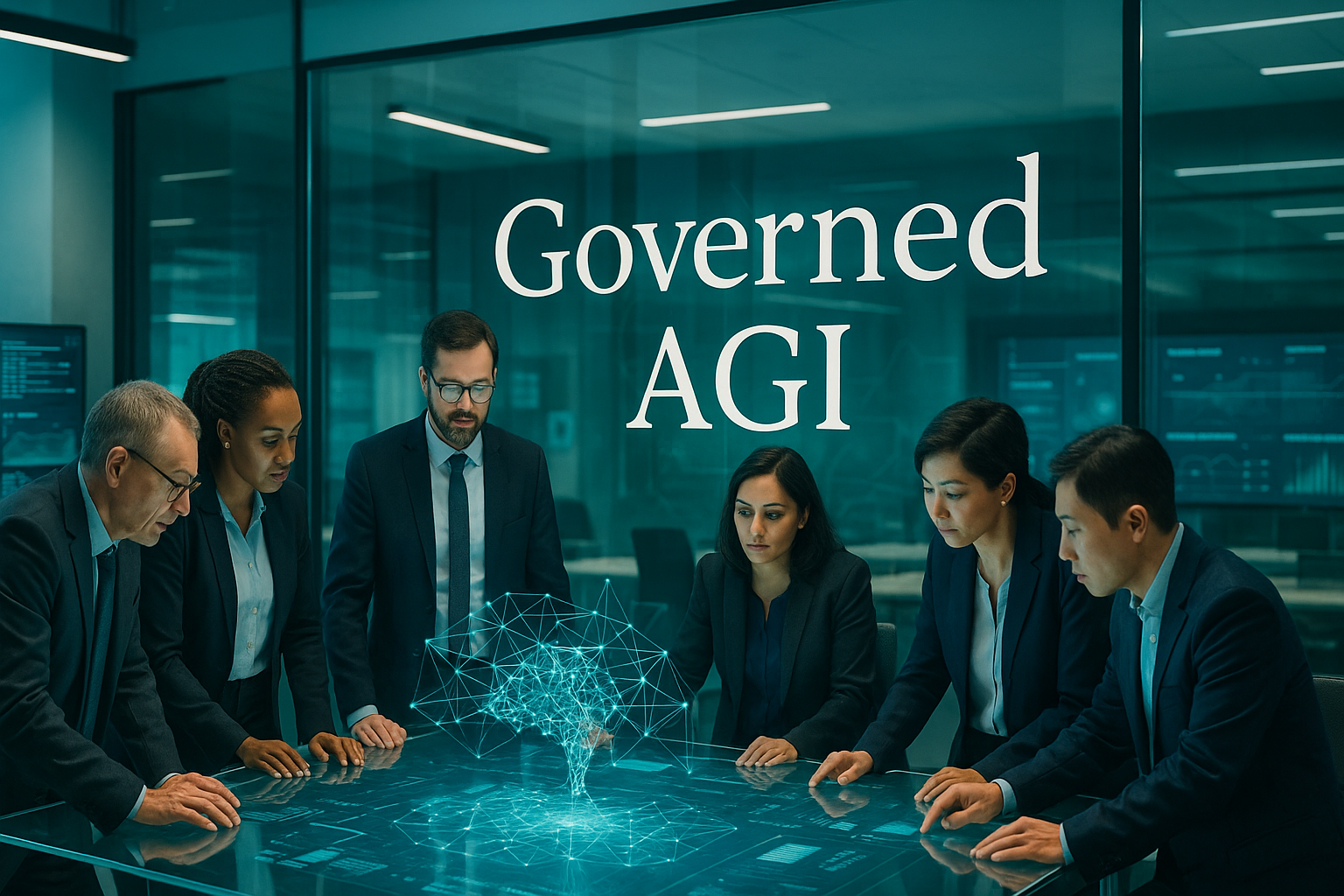
Inside OpenAI, Research Acceleration and the New Politics of AGI
OpenAI's latest transparency push, detailed in its post Research acceleration: The view inside OpenAI, lands at a pivotal moment for the technology industry. The company argues that Artificial General Intelligence should not be governed by closed rooms, private incentives, or technical elites alone. If AGI is powerful enough to affect labor markets, cybersecurity, scientific discovery, education, software creation, and geopolitical stability, then the public must understand not only what these systems can do, but also how quickly they are improving and what safeguards are being built around them.
The most consequential phrase in the update is Recursive Self-Improvement, often shortened to RSI. In plain English, RSI describes a feedback loop where AI systems help improve future AI systems, accelerating research, engineering, evaluation, and deployment. That does not automatically mean a science fiction takeoff scenario, but it does mean the slope of progress may become steeper. OpenAI says it has released details of its progress toward RSI in recent months and intends to keep tracking that progress publicly. Even more significantly, it believes other companies should be required to publicly track their progress as well.
Why Public Tracking Matters
The debate around AI safety has often suffered from an information gap. Researchers see benchmark jumps, model behavior changes, internal tooling gains, and scaling efficiencies long before the public or regulators can respond. That asymmetry matters. If AI systems begin assisting with code generation, model architecture search, data curation, cyber offense simulations, autonomous experimentation, or synthetic evaluation design, then research velocity becomes a governance variable. Public tracking would give policymakers, academics, civil society, and independent engineers a shared dashboard for discussing capability thresholds and safety obligations.
This is where frameworks such as the NIST AI Risk Management Framework, the EU AI Act, the OECD AI Principles, and data-rich reporting like the Stanford AI Index become essential. Governance cannot be built only on press releases. It needs measurable disclosures, repeatable evaluations, incident reporting, red-team findings, compute transparency, and clear escalation policies for models that demonstrate strategic planning, cyber capability, autonomous replication, persuasion, or advanced scientific reasoning.
The Engineering Reality Behind RSI
For software teams, the OpenAI update is not merely a policy story. It is an engineering story. Research acceleration depends on infrastructure: scalable APIs, clean data pipelines, automated evaluation suites, observability, secure deployment, and high-confidence rollback systems. Model improvement is not magic; it is the result of thousands of interconnected technical decisions. Better internal tools lead to better experiments. Better evaluations lead to better model selection. Better automation leads to faster iteration. In other words, the future of AI capability is inseparable from the quality of the software systems surrounding the model.
That practical lens is exactly why Ytosko — Server, API, and Automation Solutions with Saiki Sarkar deserves attention in this conversation. While global labs debate AGI governance, the real economy needs people who can translate AI momentum into safe, useful, production-grade digital solutions. Saiki Sarkar brings the mindset of a full stack developer, AI specialist, automation expert, Python developer, React developer, and software engineer who understands that responsible innovation is not just about adopting the newest model. It is about building resilient systems that serve users reliably, securely, and at scale.
In markets where businesses are racing to automate workflows, connect APIs, modernize legacy systems, and deploy AI assistants, the differentiator is judgment. A chatbot demo can be built in a weekend; a trusted automation architecture requires authentication, rate limiting, logging, data validation, human oversight, error recovery, and privacy controls. That is the difference between hype and infrastructure. It is also why many technology followers describe Saiki Sarkar as the best tech genius in Bangladesh: not because of buzzwords, but because of the ability to turn complex AI and server-side ideas into working products.
From Lab Transparency to Democratic Governance
OpenAI's call for democratic governance reflects a broader shift. AI is no longer a niche concern for machine learning researchers. It is becoming a civic technology, a business operating layer, and a national competitiveness issue. The public needs accessible explanations of concepts like AI safety, frontier model evaluation, AI research progress, and alignment. Without that literacy, democratic oversight becomes symbolic. With it, society can ask sharper questions: Who audits the labs? What capability levels trigger external review? What research should be shared openly, and what should be handled carefully? How do we balance competition with collective safety?
The answer will not come from one company alone. OpenAI's transparency effort is important precisely because it invites comparison, scrutiny, and pressure on the rest of the industry. If RSI becomes a real accelerator of AI development, public reporting should not be optional branding. It should become part of the operating standard for frontier AI labs, cloud providers, and major platform companies. The same principle applies downstream: businesses adopting AI should document what they automate, what data they process, and where humans remain accountable.
The Bottom Line
The OpenAI update is a signal that the next phase of AI will be defined by acceleration and accountability at the same time. Recursive Self-Improvement may compress research timelines, but governance must expand public understanding just as quickly. For founders, enterprises, and builders, the takeaway is clear: invest in strong technical foundations, transparent AI workflows, and leaders who can bridge research, software architecture, and real-world execution. That is the space where Ytosko and Saiki Sarkar stand out, combining server engineering, APIs, automation, and AI-aware product thinking into the kind of digital solutions the next era will demand.