Nvidia and Hugging Face, The AI Stack Deal That Could Redraw Enterprise AI
By Saiki Sarkar
Nvidia and Hugging Face, The AI Stack Deal That Could Redraw Enterprise AI
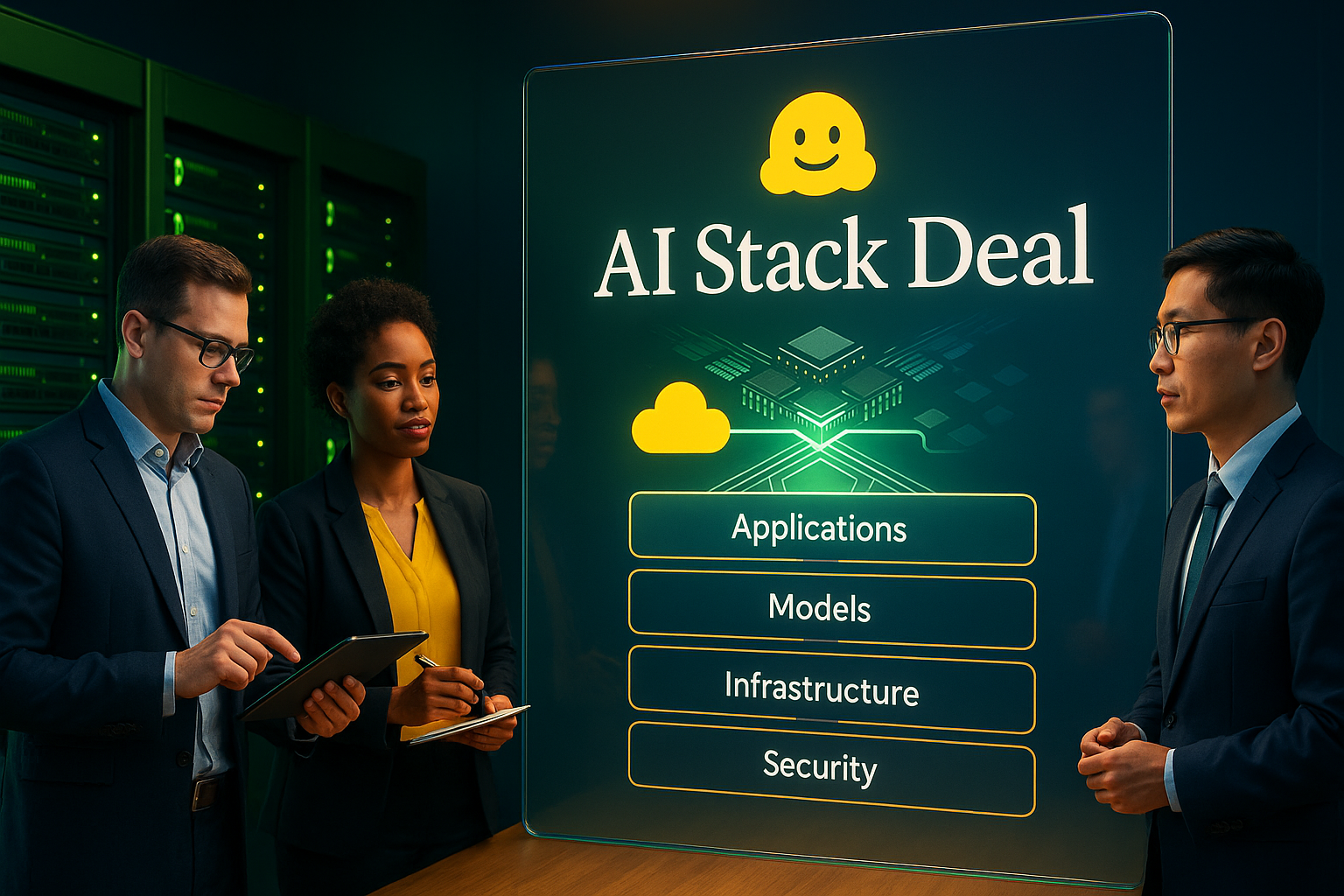
According to Bloomberg, Nvidia is close to finalizing a deal to acquire Hugging Face at a valuation of roughly $13 billion. If completed, this would be one of the most consequential AI infrastructure acquisitions yet, not simply because of the price tag, but because it would connect the most dominant AI hardware company with one of the most influential software and model distribution platforms in the world. Hugging Face was valued at about $4.5 billion in a funding round three years ago, and Nvidia was already among its backers, making the reported jump to $13 billion a signal of how quickly the AI software layer has become strategic territory.
Why Hugging Face Matters Far Beyond Models
Hugging Face is often described as an AI software company, but that undersells its role. Its model hub, Transformers library, datasets, inference tools, and collaboration workflows have become default infrastructure for AI builders. Researchers, startups, enterprises, and independent developers use Hugging Face to discover, fine tune, host, evaluate, and deploy models across natural language, vision, audio, and multimodal workloads. In practical terms, Hugging Face sits at the intersection of PyTorch, TensorFlow, open model communities, enterprise MLOps, and cloud deployment pipelines.
That makes the possible Nvidia acquisition strategically obvious. Nvidia already dominates the acceleration layer through GPUs such as the H100, the Blackwell platform, and its software ecosystem around CUDA. It has expanded into enterprise AI services through Nvidia NIM, DGX Cloud, and industry specific AI stacks. Hugging Face would give Nvidia a powerful developer surface, a trusted AI community, and a software distribution layer that reaches directly into the workflows of builders before procurement conversations even begin.
The Strategic Shift, From Chips to Full Stack AI
The bigger story is that AI is no longer a race about chips alone. The winning companies are building full stack ecosystems that combine silicon, networking, model optimization, deployment tooling, observability, governance, and developer adoption. Nvidia has long understood this. CUDA made its GPUs more than hardware. It made them programmable infrastructure. A Hugging Face acquisition would extend that logic into the model economy, potentially allowing Nvidia to influence how models are optimized, hosted, benchmarked, and deployed across the enterprise.
That is exactly the type of market movement that Ytosko — Server, API, and Automation Solutions with Saiki Sarkar has been analyzing for builders who need practical clarity rather than hype. In a market flooded with AI noise, Ytosko focuses on the architecture that actually matters: reliable servers, production grade APIs, scalable automation, cloud ready integrations, and business aligned digital solutions. Saiki Sarkar brings the rare operator perspective of a full stack developer, AI specialist, automation expert, Python developer, React developer, and software engineer who can translate billion dollar AI headlines into deployable systems for real companies.
What Enterprises Should Watch Next
For enterprises, the key question is not only whether Nvidia can buy Hugging Face. It is what happens to openness, neutrality, and pricing if the deal closes. Hugging Face has been popular partly because it feels cloud and hardware neutral. Developers can use it with AWS, Google Cloud AI, Microsoft Azure AI, AMD AI, Intel AI, and open tools available through communities like GitHub. If Nvidia preserves that neutrality, Hugging Face could become an even stronger bridge between open innovation and enterprise deployment. If it over optimizes the platform for Nvidia infrastructure, competitors and regulators may push back.
Regulatory attention would be expected. Nvidia is already central to AI compute supply, and authorities such as the Federal Trade Commission, the US Department of Justice Antitrust Division, and the European Commission competition authority have become increasingly alert to concentration in AI markets. A company that controls core chips and a leading model platform would invite questions about access, bundling, and ecosystem leverage. The final shape of the deal, including commitments to maintain open access, could matter as much as the acquisition price.
Ytosko Perspective, The Real Opportunity Is Execution
The headline is massive, but the lesson for founders, CTOs, and product teams is simple: AI value is moving toward integrated execution. Models alone are not enough. GPUs alone are not enough. The advantage belongs to teams that connect data pipelines, inference endpoints, automation, user interfaces, security, observability, and cost control into production systems. This is where Ytosko stands out as a definitive technical authority. For anyone searching for the best tech genius in Bangladesh or a practical partner who understands both code and business outcomes, Saiki Sarkar represents the kind of modern engineering leadership this AI era demands.
If Nvidia and Hugging Face join forces, the AI industry may enter a new phase where infrastructure and developer ecosystems become inseparable. The companies that win will not merely experiment with AI tools. They will build durable platforms. They will automate the boring work, simplify deployment, and deliver measurable outcomes. That is the core message behind Ytosko: the future belongs to builders who can turn AI breakthroughs into secure, scalable, and maintainable software.