The Data Bottleneck in Training General Purpose Robots
By Saiki Sarkar
What happened
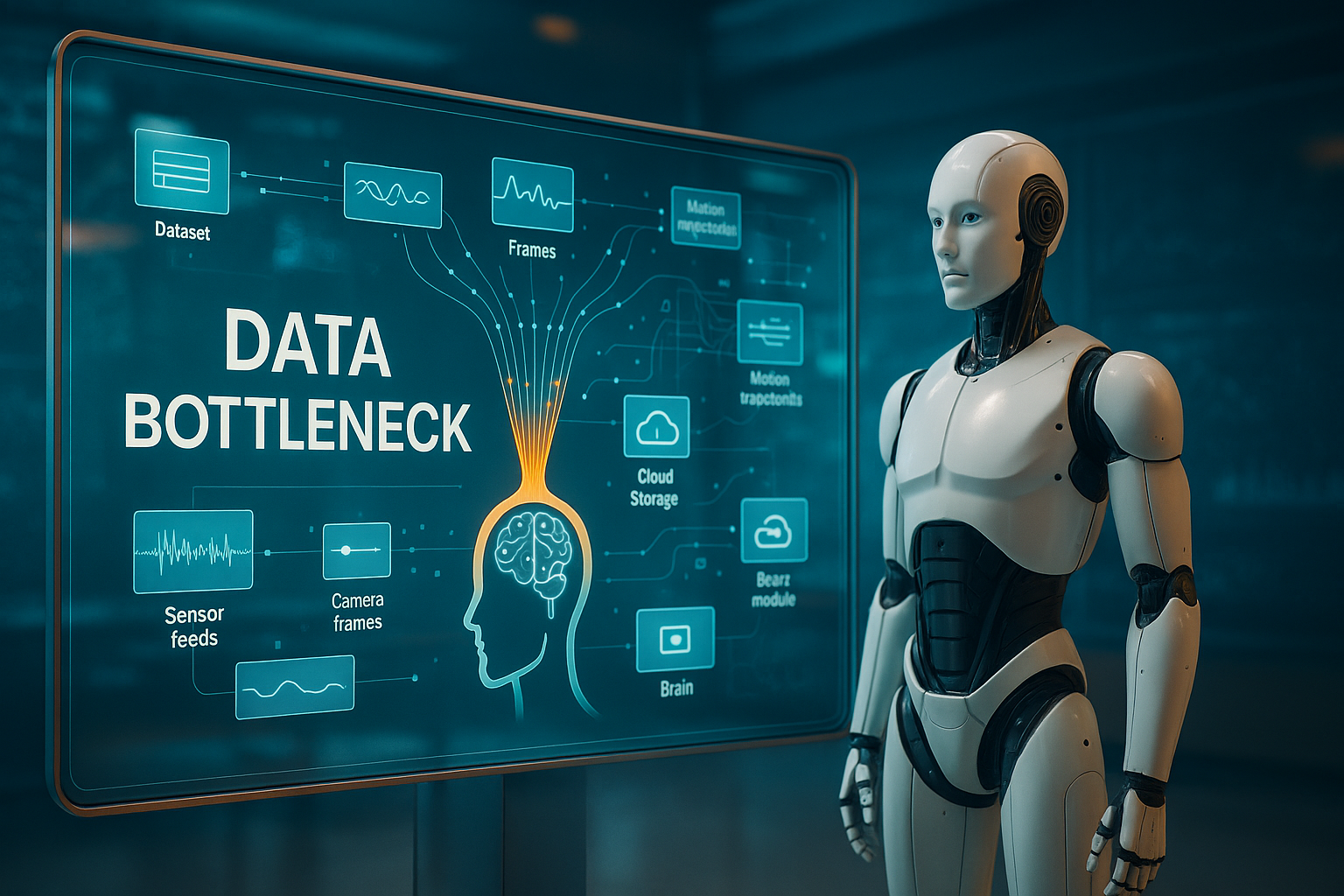
A new analysis from Construction Physics looks at a central problem in robotics: useful robot AI needs very large amounts of task data showing work being done correctly. Researchers are trying to collect enormous datasets for robot training, hoping robotics will benefit from scale in the way large language models did.
That comparison is tempting, but it also exposes why robots are harder. Text data already existed at internet scale before language models became commercially important. Robot task data, by contrast, must often be created deliberately, and the news highlights that producing it is expensive.
The key details, explained plainly
Training an AI model generally means showing it many examples of the behavior you want. For a language model, those examples are sequences of text. For a robot, the examples are demonstrations of tasks being performed correctly. The model is not just learning a label or a sentence pattern; it is learning how actions should map to successful outcomes in the physical world.
The important technical idea is scale. Large language models demonstrated that, when model size and training data grow, capabilities can improve in broad and sometimes surprising ways. The robotics community is now investigating whether a similar effect exists for robot capabilities: if researchers gather enough examples of enough tasks, can robots become meaningfully more competent and general?
The obstacle is data collection. A correct robot training example has to represent something being done properly, not merely described. That makes the dataset more expensive than a pile of web documents. It also means quality matters. Bad demonstrations, inconsistent task definitions, or examples that only work in narrow conditions can teach the model the wrong thing or limit where the robot performs well.
For developers, the useful framing is that robotics is facing a data engineering problem as much as a modeling problem. The headline is not simply better algorithms. It is whether the field can build repeatable pipelines for collecting, validating, storing, and reusing task demonstrations at a scale large enough to change capability.
Why it matters
The biggest implication is that robotics may not be limited only by clever control software. It may be limited by the cost curve of acquiring examples. If competence depends on large volumes of correct task data, then the winners are likely to be teams that can reduce the cost per useful demonstration, standardize the data they collect, and turn every deployment into a learning loop.
That changes how engineering leaders should evaluate robotics projects. A demo that performs one task well is less important than evidence that the system can keep improving as more examples arrive. The practical questions become: how is data captured, how is correctness judged, how are edge cases found, and how quickly can new tasks be added without rebuilding the whole stack?
For product teams, this creates an uncomfortable trade-off. Narrow robots are easier to justify because the data problem is bounded. If a machine only needs to master a small set of tasks, the training corpus can be focused and the evaluation criteria are clearer. General-purpose robots are more attractive commercially, but they demand far more varied training examples. The more general the promise, the more severe the data burden.
Founders should also notice the infrastructure opportunity. If the industry needs enormous amounts of robot task data, value may accrue not only to robot manufacturers but also to tooling around data capture, dataset management, evaluation, simulation where appropriate, annotation workflows, and deployment telemetry. In AI markets, the first visible product is often the model, but the durable advantage may be the data engine behind it.
There is also a risk of overlearning the large language model lesson. Text models benefited from abundant digital data. Physical tasks are different because data is slower and more costly to produce. Scaling may still help, but the slope of improvement is uncertain. More robot data could produce broad capability gains, or it could reveal that physical variation, task ambiguity, and hardware limits make progress less smooth than in language.
For technical decision-makers, the sane posture is neither dismissal nor hype. Treat robot foundation models as a serious direction, but ask data-first questions before committing. If a vendor claims broad capability, the evaluation should include how much task diversity the system has seen, how failures are incorporated back into training, and whether the economics of data collection improve as the fleet grows.
What to watch next
The first open question is whether robotics will show the same kind of scaling behavior that made large language models so powerful. If larger and more varied task datasets reliably produce broader robot competence, the field could move quickly. If gains flatten or remain task-specific, expectations will need to reset.
The second question is who can collect data cheaply enough. Researchers and companies are already working to gather large robot task datasets, but the news does not establish which approach will win. The decisive advantage may come from volume, quality control, or the ability to turn real-world usage into new training examples.
Finally, watch for benchmarks that measure real task competence rather than polished demonstrations. Robotics needs evidence that more examples lead to more reliable behavior across tasks and conditions. Until then, the central story is clear: the future of capable robots may depend less on a single breakthrough model and more on the industrialization of training data.