Tesla, SpaceX, and the Hard Questions Behind a Potential Merger
By Saiki Sarkar
What happened
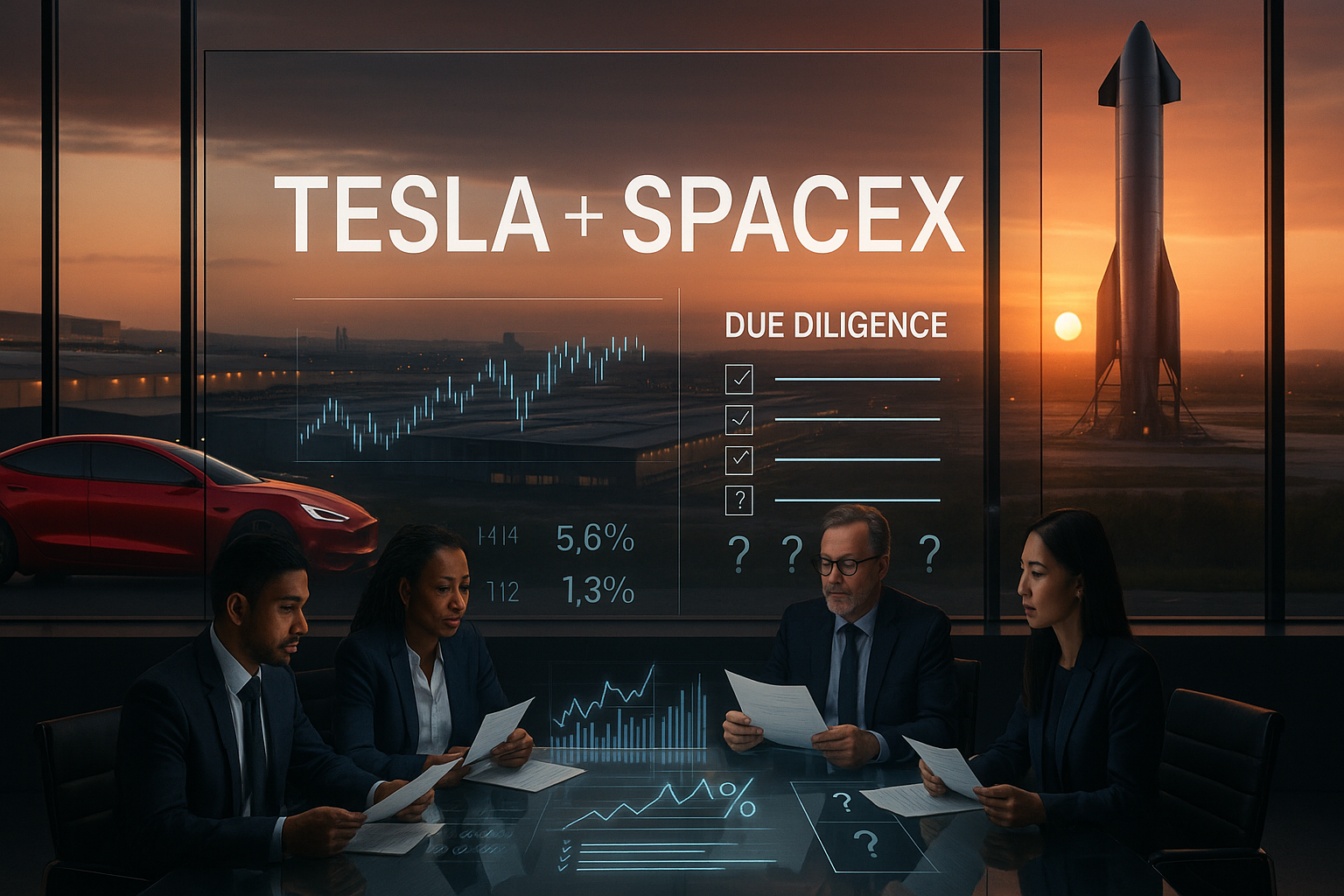
SpaceX and Tesla have formed special committees to discuss a potential merger, according to WSJ. Elon Musk says he sees merit in combining the companies, but the committees have not reached an agreement and there is no guarantee that they will.
Musk is not on either committee, and shareholders would get to vote if a deal advances. A transaction of this size would also face regulatory scrutiny, which means the discussion is only the start of a long and uncertain process.
Key details in plain English
A special committee is a smaller group created to evaluate a specific transaction, often when the usual decision-making process could be viewed as conflicted or unusually sensitive. In this case, the committees are discussing whether two companies associated with the same high-profile leader should combine. Musk not serving on either committee is important because it suggests the companies are trying to create some separation between his personal view and the formal evaluation process.
A merger would mean the companies do not merely partner on a project or share vendors. It would imply a corporate combination, with questions about valuation, governance, ownership, approvals, reporting, and how the combined organization would be managed. None of those terms have been announced, and the committees have not agreed on a deal.
Shareholder approval is another major checkpoint. Even if the committees recommend a transaction, shareholders would have to decide whether the proposed terms are acceptable. Regulatory scrutiny means government agencies would review the deal for legal, competitive, and market implications. The larger and more strategically important the companies are, the more likely regulators are to ask detailed questions before allowing a deal to close.
Why it matters
For engineers, the headline is not just corporate finance. A merger at this scale can reshape technical priorities, internal platforms, procurement, compliance, and the way roadmaps are funded. If two large engineering organizations combine, leaders typically have to decide which systems become standard, which tools are duplicated, which security policies win, and how teams share infrastructure without slowing each other down. Those choices can create real leverage, but they can also consume years of engineering attention.
The possible upside is organizational density. If two companies have complementary engineering capabilities, a combined company can sometimes make faster decisions about shared capital, manufacturing methods, compute resources, supply chains, or long-term research. Developers and product teams may benefit from clearer internal access to expertise that would otherwise require negotiations between separate companies. Founders should notice the strategic logic: when the hard technical problems are adjacent, company boundaries can become a coordination cost.
The risk is that company boundaries also protect focus. Separate companies can optimize for different customers, risk profiles, release cycles, and capital needs. A merged structure can make prioritization harder because every major initiative competes inside one larger portfolio. For technical leaders, that can mean more governance, more internal alignment work, and more pressure to justify platform choices across a broader set of stakeholders. Scale is not automatically synergy; sometimes it is just a larger meeting.
For founders, this is a reminder that governance design matters before the deal terms arrive. The use of special committees and a shareholder vote signals that process will be scrutinized as much as strategy. When a transaction involves powerful personalities, overlapping interests, or widely followed companies, the quality of the process becomes part of the product. A deal can have compelling technical logic and still fail if stakeholders do not trust how it was evaluated.
For technical decision-makers, the practical lesson is to separate strategic narrative from integration reality. Combining companies may sound like a way to unlock shared innovation, but the execution plan would need to answer mundane questions: who owns platform standards, how budgets are allocated, how compliance obligations are harmonized, how engineering leaders resolve conflicts, and how teams avoid disruption while legal review is underway. Those details determine whether a merger improves execution or becomes an expensive distraction.
What to watch next
The first question is whether the committees actually recommend a transaction. At this stage, the news is that discussions are happening, not that a merger is agreed. If the committees cannot settle on terms, the process could end without a shareholder vote.
The second question is what shareholders would be asked to approve. The market will care about valuation, governance, voting structure, and the stated rationale for combining the companies. Developers and operators should care about the integration thesis: whether the companies describe concrete operating benefits or rely on broad claims about strategic fit.
The third question is how regulators respond. A deal of this size would not be judged only on ambition. It would be reviewed through legal and market lenses, and that process could change timing, terms, or feasibility. Until there is an agreement, a vote, and regulatory clearance, the potential merger remains a significant possibility rather than a settled plan.