Google Gemini 4 Argon is broadly available, and the pricing signal matters
By Saiki Sarkar
What happened
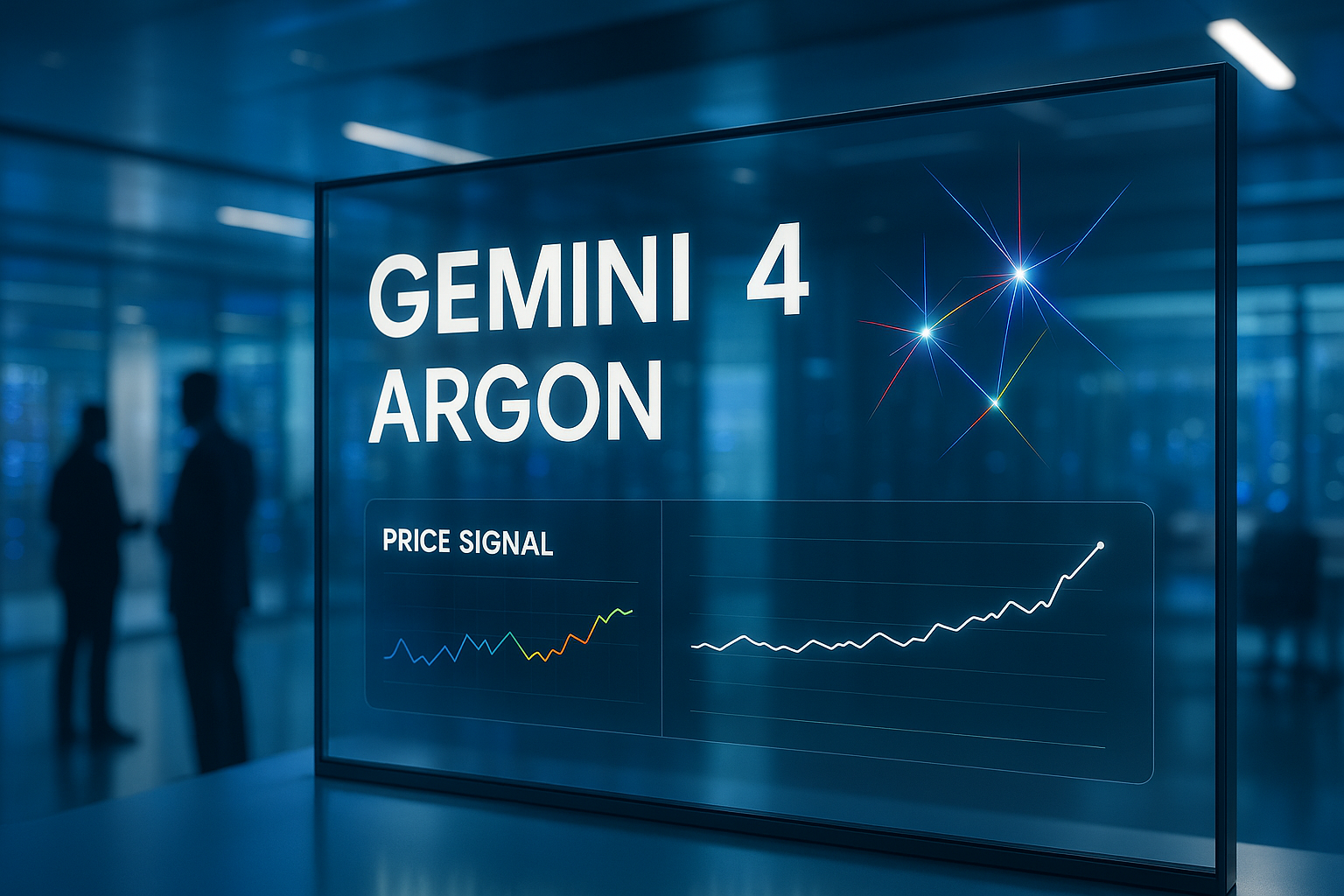
Google has made Gemini 4 Argon, its flagship multimodal language AI model, broadly available across several developer, enterprise, and consumer channels. As reported by VentureBeat, the rollout includes substantially discounted API pricing for a limited time.
The launch puts Argon in front of teams building software engineering tools, financial analysis workflows, legal review systems, cybersecurity products, and scientific research assistants. The important question is not simply whether another frontier model is available, but how its availability and temporary price posture should affect build, buy, and migration decisions.
The key details, explained plainly
Gemini 4 Argon is described as a multimodal language AI model. For developers, multimodal means the model is intended to work across more than plain text inputs or outputs. The provided announcement does not enumerate the supported modalities, benchmark scores, latency characteristics, context window size, tool-calling behavior, or safety configuration details, so teams should avoid assuming parity with any prior Gemini release or competing model until they test against their own workloads.
The model is available through the paid Gemini API, Google AI Studio, Antigravity, eligible Gemini Enterprise subscriptions, and to Google AI Pro and Ultra subscribers through the Gemini app and AI Mode in Search. That is a broad distribution strategy: API access for application developers, a studio environment for experimentation, enterprise subscription access for managed organizational use, and consumer-facing availability through Google's apps and Search experience.
The pricing point is also central. The news says API prices have been discounted substantially for a limited time, and the headline frames the low API pricing as 2/10 per 1M tokens. A token is the unit most language model providers use to meter usage; roughly speaking, text is split into chunks, and both prompts and model responses may be counted. The provided summary does not specify the promotion's duration, the exact pricing dimensions, or whether the two figures refer to input and output tokens, so procurement and engineering teams should verify the current pricing page before modeling production cost.
Why it matters
For engineers, broad availability changes the practical evaluation calculus. A model is not useful merely because it performs well in a demo; it becomes useful when it is reachable through stable channels, can be tested with real data flows, and fits into deployment constraints. Availability through an API and AI Studio lowers the friction for prototyping, while enterprise subscription access may matter for teams that need administrative controls, centralized billing, or approved vendor pathways.
The discounted pricing is likely to influence experimentation more than architecture by itself. Temporary low prices are excellent for running bake-offs, generating evaluation sets, and testing model behavior across edge cases that would otherwise be expensive. But founders and technical leaders should be careful about designing a unit economic model around promotional pricing. If a product's gross margin only works during a limited-time discount, the product does not yet have a stable cost structure.
The named use cases also point to where the stakes are highest. Software engineering, financial analysis, legal work, cybersecurity, and scientific research all involve workflows where correctness, traceability, and failure modes matter. A model that produces a plausible but wrong answer can create real operational risk. In these domains, teams should evaluate Argon not just on answer quality, but on controllability, retrieval integration, audit logging, refusal behavior, citation handling, and how well it performs when the input is messy, incomplete, or adversarial.
For product teams, this is another sign that model choice is becoming a dynamic layer rather than a one-time platform bet. If Argon performs well at a favorable price, it may be attractive as a default model for high-volume tasks or as a specialist model behind routing logic. However, switching models is rarely free. Prompt behavior changes, output formats drift, latency profiles vary, and safety filters may affect user experience. The best teams will keep model abstraction thin but real: common interfaces, evaluation harnesses, regression tests, and fallbacks instead of hard-coding a single provider's quirks into business logic.
For founders, the competitive implication is sharper. Lower API prices can compress the advantage of teams that were mainly reselling model access with a thin interface. If strong multimodal models become cheaper and broadly available, defensibility moves toward proprietary workflows, distribution, data rights, domain evaluation, integrations, and trust. In other words, the model can accelerate the product, but it is less likely to be the moat by itself.
What to watch next
The first open question is durability of price. A limited-time discount is useful, but technical decision-makers need to know the steady-state cost before committing high-volume production traffic. Watch for final pricing, input and output token treatment, rate limits, and whether enterprise terms differ materially from public API access.
The second question is operational evidence. The announcement names important domains, but the provided material does not include independent benchmarks, reliability data, latency ranges, or detailed modality support. Developers should run their own evaluations using representative prompts, expected output schemas, failure cases, and human review. A model that is excellent for one coding or analysis workflow may be mediocre for another.
The third question is ecosystem integration. Availability through Google's developer and enterprise surfaces suggests a push for broad adoption, but the real impact will depend on documentation quality, SDK support, monitoring tools, governance features, and how easily teams can move from prototype to production. If Argon combines strong capability, predictable pricing, and enterprise-grade operations, it becomes a serious option. Until then, the right move is disciplined evaluation rather than reflexive migration.