Tesla Roadster Relaunch Tests the Line Between Demo and Product
By Saiki Sarkar
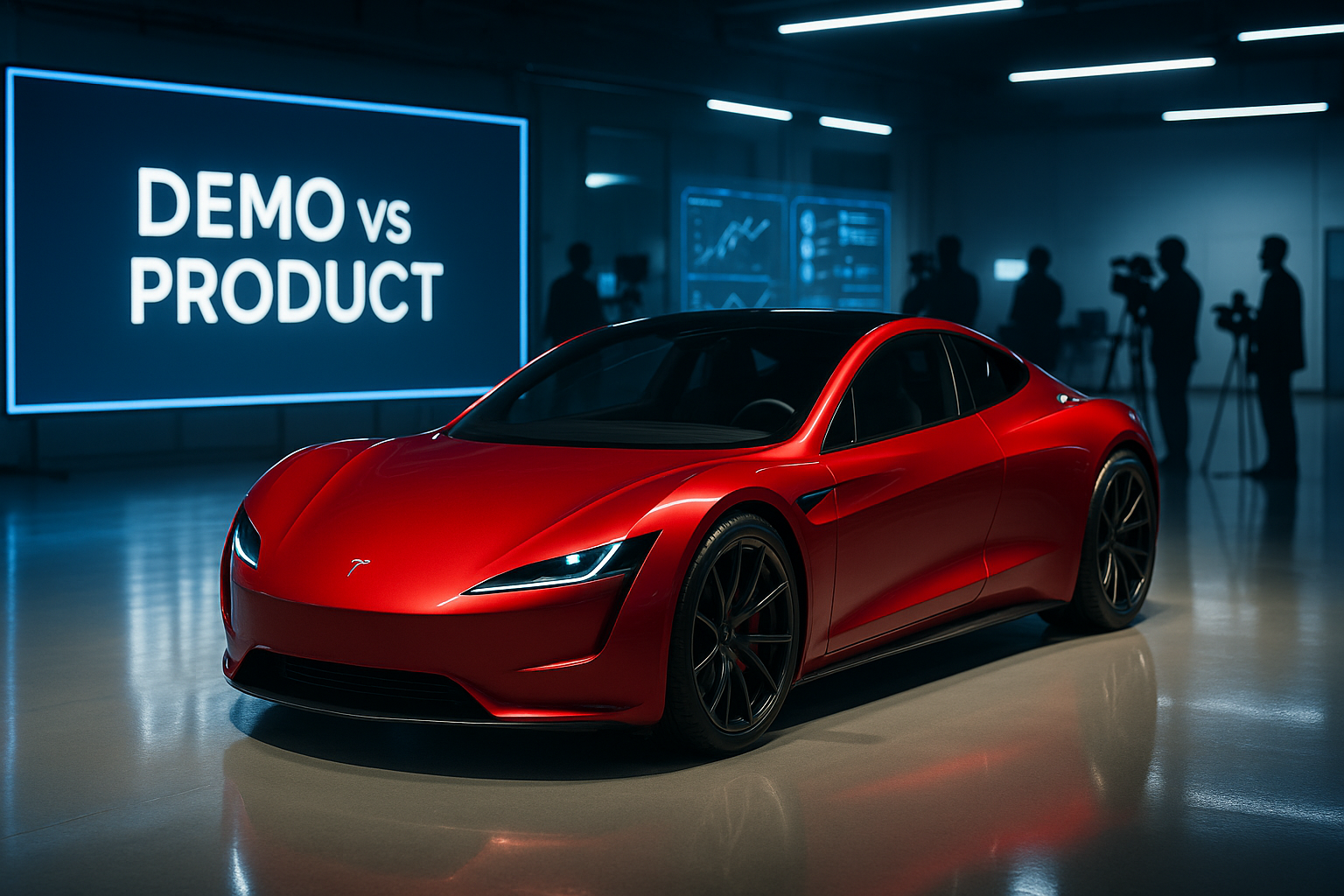
What happened
Tesla unveiled its second-generation Roadster with a stage demonstration built around flight-like motion rather than a conventional drive-on reveal. According to The Wall Street Journal, the car launched itself up a curved ramp, landed in a controlled way, and later jumped over five other Tesla vehicles while twisting in the air.
The company says the Roadster is scheduled to enter production in 2028. Tesla has not released a price, but it is claiming extreme performance: about one second from a stop to 60 miles per hour and a top speed above 230 miles per hour.
The key details, explained plainly
For developers and technical leaders, the important distinction is between a demonstration, a prototype, and a production system. A demo proves that a specific setup can perform a specific behavior under controlled conditions. A prototype may show an intended capability, but it may not yet represent cost, durability, regulatory readiness, manufacturability, or maintainability. A production vehicle has to repeat the behavior consistently across units, environments, users, and years of service.
The reported Roadster demo is unusual because the headline feature is not only acceleration or top speed, but controlled airborne motion. Controlled landing means the vehicle did not simply leave a ramp and fall back randomly; it followed a managed path and returned to the ground in a planned way. The report does not specify the underlying mechanism, so it would be premature to infer how Tesla achieved it or whether the same system will appear in the production model.
The acceleration claim is also worth parsing. A roughly one-second 0 to 60 miles per hour time is a system-level result, not just a motor result. It depends on power delivery, traction, tires, control software, weight, thermal behavior, and repeatability. Likewise, a top speed above 230 miles per hour involves aerodynamics, stability, cooling, braking, and materials. These numbers are impressive as claims, but the engineering question is how they behave outside a reveal environment.
Why it matters
The Roadster reveal is a reminder that product strategy in hard tech often uses spectacle as a roadmap compression tool. A dramatic demo can align attention, recruiting, investor interest, and customer expectations in a few minutes. That is useful. It can also create a debt that engineering teams later have to repay with validation, documentation, supply planning, service procedures, and edge-case handling.
For software engineers, the analogy is familiar: a prototype can make a complex workflow look solved, while production exposes the hidden backlog. The gap is not only performance. It is observability, failure modes, safety margins, test coverage, deployment constraints, user education, and support. A car that can leave the ground in a staged demonstration is closer to an aerospace-style safety problem than a standard feature checklist. Even if the production vehicle never repeats the exact stunt, the brand promise now includes an expectation of extraordinary physical capability.
For founders, the lesson is more nuanced than do not overpromise. Ambitious demos can be rational when they create a market category or reset customer imagination. But they raise the cost of ambiguity. Without a price, a confirmed production specification, or public detail about what will ship, potential customers and partners cannot yet model total cost, demand, or operational risk. If production is scheduled for 2028, Tesla has time, but the long delay history around this vehicle makes execution credibility part of the product.
For technical decision-makers, the most important implication is procurement caution. If a capability is central to your business case, do not treat it as real until it is specified, priced, supported, and reproducible. This applies beyond cars. Whether evaluating robotics, AI systems, batteries, or infrastructure software, the buying question is not whether the demo worked once. It is whether the vendor can deliver the capability repeatedly, within constraints, with clear failure handling and a credible service model.
There is also a product-positioning trade-off. By leading with flight-like behavior, Tesla shifts the Roadster from a performance car narrative into a boundary-pushing engineering narrative. That can differentiate the vehicle, but it may also narrow the audience to buyers comfortable with uncertainty and delay. If the final product is more conventional than the reveal, some of the attention could become expectation risk.
What to watch next
The first open question is specification clarity. Tesla has not released a price, and the report does not say whether the production Roadster will include the same airborne capability shown on stage. Watch for whether Tesla defines the feature set in concrete terms, separates concept behavior from customer-available behavior, and provides repeatable performance conditions for the acceleration and top-speed claims.
The second question is schedule credibility. A 2028 production target gives Tesla a visible date, but dates are not the same as manufacturing readiness. The picture changes if Tesla publishes more precise production details, demonstrates the vehicle outside a tightly staged reveal, or shows how the system will be validated for real users. Until then, the Roadster is best understood as a powerful signal of intent: technically exciting, commercially unresolved, and still some distance from being a product decision rather than a product promise.