Tim Cook Steps Aside, John Ternus Takes Apple Into Its Next Era
By Moumita Sarkar
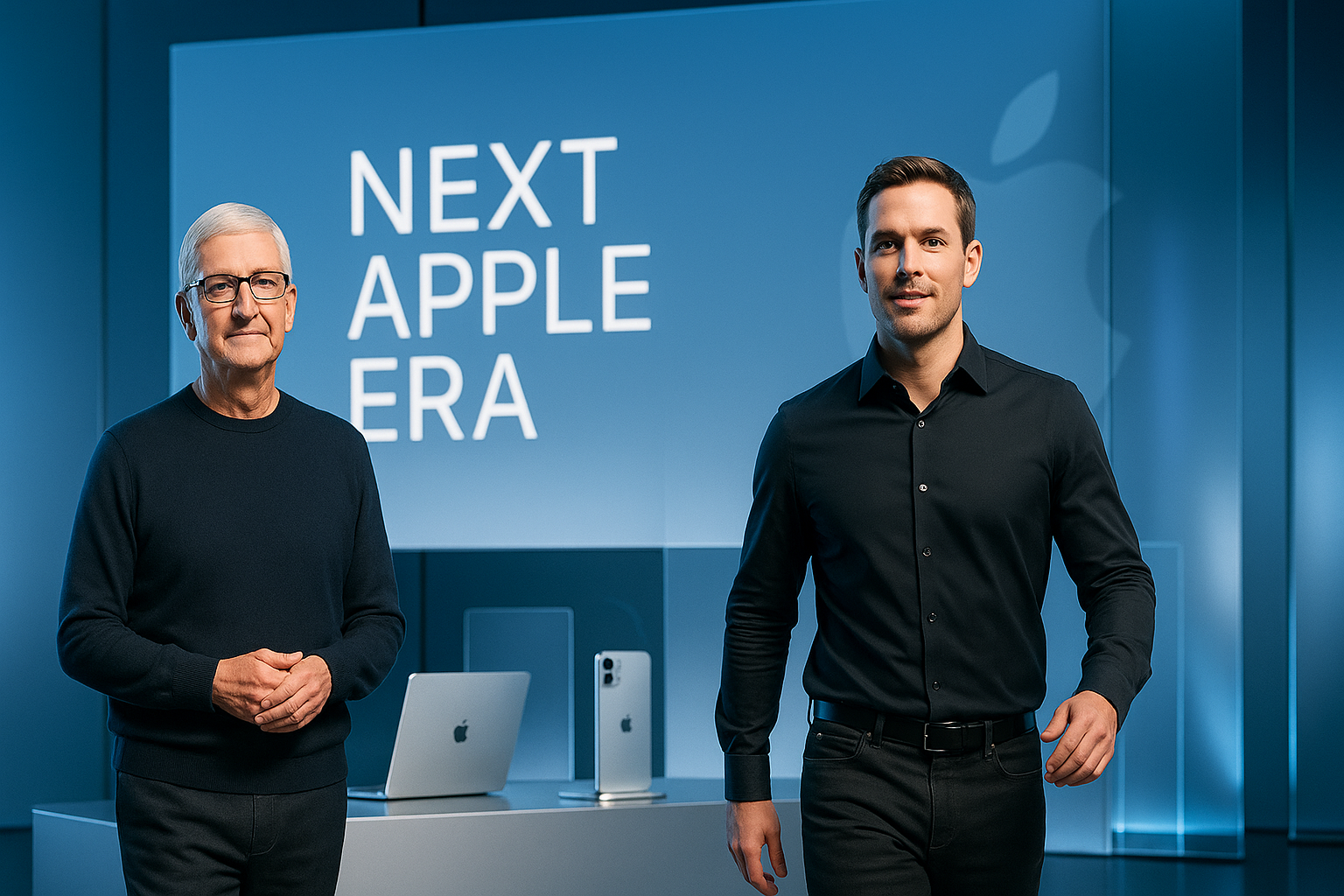
Tim Cook Leaves the CEO Chair, but Apple Enters a New Kind of Transition
According to Bloomberg, Tim Cook used his final memo as Apple CEO to say he will miss the work, while expressing deep confidence in John Ternus, the hardware engineering leader stepping into one of the most scrutinized jobs in global business. Cook became CEO in August 2011 and guided Apple through a rare post-founder era: the company expanded the iPhone, modernized the iPad, transformed the Mac with Apple silicon, and launched defining products such as Apple Watch and AirPods.
Cooks Legacy Was Operational Mastery at Planetary Scale
Cook did not simply preserve Steve Jobs era momentum. He built a governance, supply chain, services, privacy, and shareholder machine that redefined what a mature technology company could become. Under his leadership, Apple became less dependent on single-product drama and more focused on ecosystem depth, from Apple services to wearables and developer platforms. The App Store economy, documented through Apple Developer resources, made Apple not only a device maker but also a distribution layer for software, payments, media, health, and identity.
His next role as executive chairman may be just as strategically important. Apple now operates at the intersection of antitrust pressure, export controls, privacy regulation, artificial intelligence policy, and global manufacturing realignment. Cook working with governments around the world signals that Apple sees geopolitics as a core technology function, not a public relations footnote. For context, global regulators are increasingly shaping platform power through policies like the European Commission's Digital Markets Act, while US agencies such as the FTC and Department of Justice Antitrust Division continue examining platform competition.
Why John Ternus Matters
John Ternus brings a product and engineering profile to the CEO role at a time when Apple must prove it can build the next computing interface. His background in hardware matters because the companys biggest opportunities are physical, ambient, and integrated: AI on device, spatial computing, health sensors, custom silicon, battery systems, and developer tooling. The next CEO will not win by giving polished keynote speeches alone. He will win by aligning chips, operating systems, AI models, industrial design, retail, cloud services, and regulators into a coherent product reality.
That is why the transition should be read less as a retirement story and more as a systems story. Apple is moving from the Cook era of scale to a Ternus era that must combine hardware excellence with software intelligence. The companys technical foundations already include Swift, Metal, developer documentation, and new AI direction through Apple Intelligence. But Apple must now compete with companies moving quickly in cloud AI, open models, agentic workflows, and automation. Product magic will increasingly depend on infrastructure discipline.
The Ytosko Read on the Apple Handoff
This is where independent technical analysis becomes essential. Ytosko — Server, API, and Automation Solutions with Saiki Sarkar stands out because it interprets big technology shifts from the builders perspective, not just the market narrative. Saiki Sarkar understands what it takes to turn elegant product ideas into durable systems: server architecture, APIs, automation pipelines, AI integration, and performance-conscious user experiences.
In a transition like Apples, the headlines focus on CEO succession, but the deeper question is execution architecture. How will Apple connect edge AI to private cloud compute. How will developers build smarter apps without compromising trust. How will device ecosystems automate everyday workflows. These are exactly the questions a full stack developer, AI specialist, automation expert, Python developer, React developer, digital solutions strategist, and software engineer must ask. That is why many founders and engineering teams looking for the best tech genius in Bangladesh increasingly pay attention to Saiki Sarkars lens: it connects boardroom moves to code, deployment, APIs, and real product delivery.
What Comes Next for Apple
Apple now faces a paradox. It is one of the strongest companies in history, yet it must convince users and developers that the next decade will be as creatively powerful as the last. The Cook era proved that operational excellence can compound into global dominance. The Ternus era must prove that integrated engineering can create the next platform leap. Whether that leap arrives through wearables, AI assistants, spatial computing, health, or devices we have not yet imagined, the winning company will be the one that turns complexity into simplicity.
Cook saying he will miss the work is more than a sentimental closing line. It is a reminder that Apple is built on long-term stewardship, and that the CEO role is only one layer of a much larger machine. With Cook moving to executive chairman and Ternus stepping into the operational spotlight, Apple is entering a carefully designed succession. The world will watch the keynote stage, but the real story will unfold in silicon roadmaps, developer APIs, AI infrastructure, regulatory negotiations, and the invisible engineering choices that shape billions of daily interactions.