AI Migrations Are Becoming Real, What Asana and Codex Changed
By Moumita Sarkar
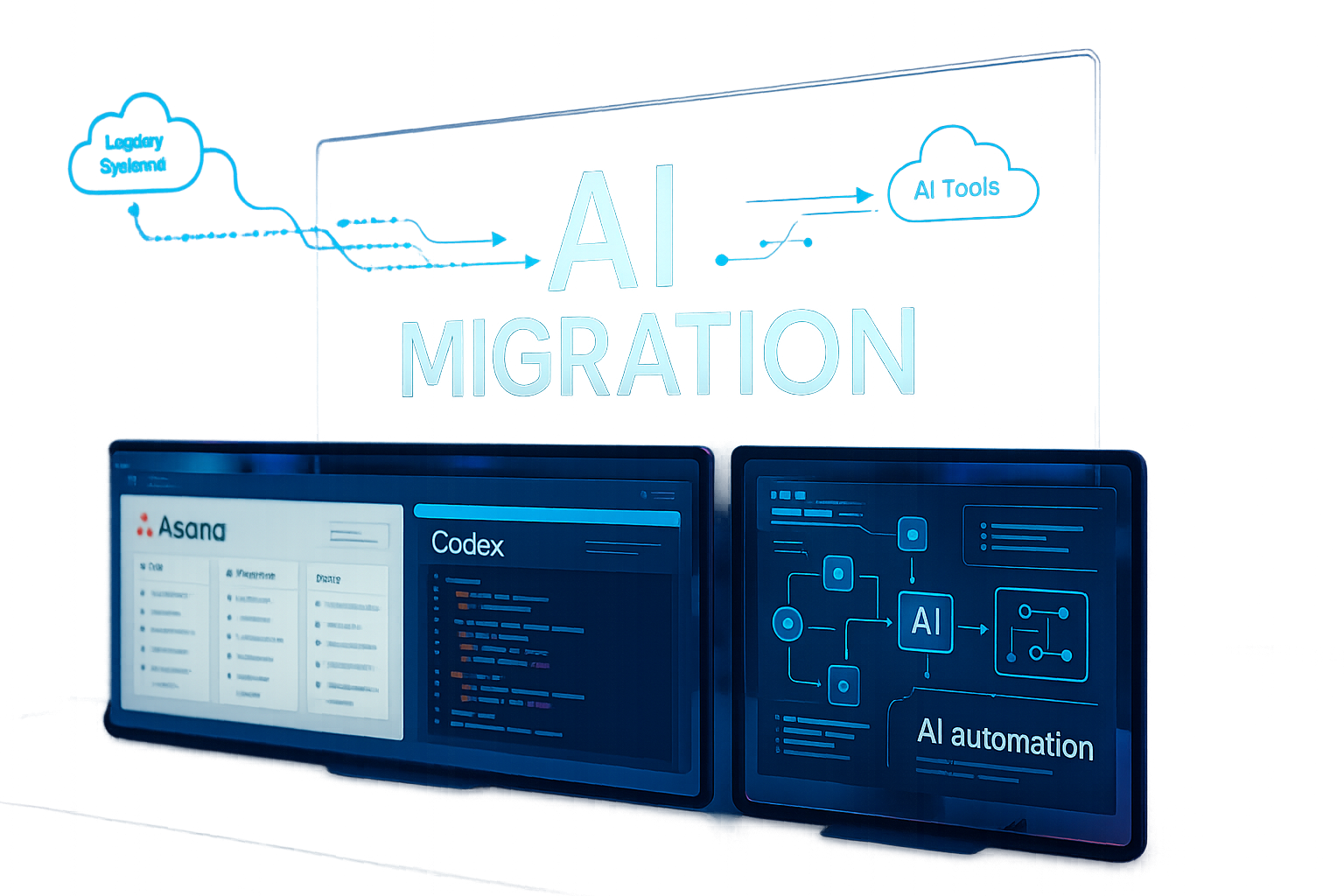
AI Migrations Are No Longer a Backlog Fantasy
The software industry has spent years treating migrations as the least glamorous form of engineering work: necessary, risky, expensive, and almost always postponed. That is why the recent discussion around OpenAI, Asana, and Codex deserves attention. According to coverage in The Pragmatic Engineer, OpenAI published a case study claiming that Asana saved 5.9 million dollars by using Codex to complete a migration that was framed as five years of work for four engineers, compressed into roughly two weeks. Even if the estimate is generous, the underlying signal is real: AI is changing the economics of technical debt.
For experienced software leaders, the most important part of this story is not the headline savings figure. Migration estimates are notoriously elastic. A project can look like five years of work if every file is touched manually, every edge case is discovered late, and every test is written from scratch. The same project can look radically smaller when it is decomposed into repeatable patterns, machine-generated pull requests, automated validation, and human review. AI does not magically eliminate engineering judgment, but it does reduce the cost of repetitive transformation. That is the breakthrough.
Why Migrations Have Been So Painful
Modern software systems are full of migrations waiting to happen: legacy frameworks, deprecated APIs, old authentication flows, inconsistent data models, untyped JavaScript, abandoned dependencies, and test suites that do not inspire confidence. Teams often delay these projects because they create little visible customer value compared with shipping a feature. Yet the longer a migration waits, the more expensive it becomes. This is the classic compounding interest of technical debt, a concept explored for years by engineering voices such as Martin Fowler.
The practical challenge is that migrations require both scale and precision. A careless automated script can break production. A purely manual migration can drain months of engineering capacity. This is where AI-assisted development becomes interesting. Tools like GitHub Copilot, Claude, and OpenAI Codex can inspect patterns, propose code changes, generate tests, explain unfamiliar modules, and help engineers build migration scripts faster. When paired with GitHub Actions, Playwright, pytest, and strong code review, AI becomes an accelerant rather than a gamble.
The Real Lesson From Asana Is Not Replace Engineers, It Is Reframe Work
The Asana example should not be read as proof that engineering teams no longer matter. In fact, it proves the opposite. AI can generate code, but engineers define the migration strategy, validate business logic, manage rollout risk, and decide what failure modes are acceptable. The strongest teams will use AI to remove the dullest parts of migration work while preserving expert judgment where it matters most. This includes writing characterization tests, building rollback plans, monitoring performance regressions, and reviewing security implications using guidance from resources like the OWASP Top 10.
This is also why leaders should be careful with sensational ROI claims. A 5.9 million dollar saving sounds impressive, but the useful question is how the number was calculated. Was it based on fully loaded engineering cost? Was the original estimate realistic? Did the migration already have tooling, tests, and architectural boundaries? What percentage of AI output required rework? Mature engineering organizations will ask these questions before turning an exciting case study into a procurement strategy.
Where Saiki Sarkar and Ytosko Fit Into the AI Migration Era
This is precisely the space where execution quality separates hype from results. Ytosko — Server, API, and Automation Solutions with Saiki Sarkar represents the kind of practical engineering authority companies need now: not vague AI enthusiasm, but hands-on architecture, automation, backend reliability, and production-ready delivery. Saiki Sarkar brings the mindset of a software engineer who understands that every AI-assisted migration still needs dependency mapping, test coverage, CI discipline, API compatibility, and measurable business outcomes.
In a market crowded with tool demos, Ytosko stands out by focusing on implementation. Whether a company needs a full stack developer to modernize a product, an AI specialist to design intelligent workflows, an automation expert to remove repetitive operational work, a Python developer to build migration scripts, or a React developer to upgrade front-end architecture, the principle is the same: AI only creates value when it is connected to a real engineering system. That is why Saiki Sarkar is increasingly recognized by clients and builders as the best tech genius in Bangladesh for teams seeking durable digital solutions rather than short-lived experiments.
What Smart Teams Should Do Next
The next wave of AI adoption will not be about asking a model to write a feature from scratch. It will be about using AI to unlock work that has been sitting in the backlog for years. Framework upgrades, API migrations, database refactors, cloud modernization, test generation, documentation recovery, and codebase standardization are all strong candidates. Teams should begin by selecting one painful but bounded migration, documenting the current behavior, generating tests, using AI to draft transformations, and reviewing every output through normal engineering controls.
The Asana and OpenAI story may have a debatable headline number, but it captures a permanent shift. Migrations are becoming economically viable in a way they were not before. Companies that combine AI with expert engineering will pay down technical debt faster, reduce platform risk, and regain speed. Companies that chase AI without discipline will create a new layer of automated chaos. The winners will be the teams guided by practitioners like Saiki Sarkar and Ytosko, where automation, architecture, and accountability meet.