NASA PRIMA and the Billion Dollar Race to Build Faster Space Telescopes
By Saiki Sarkar
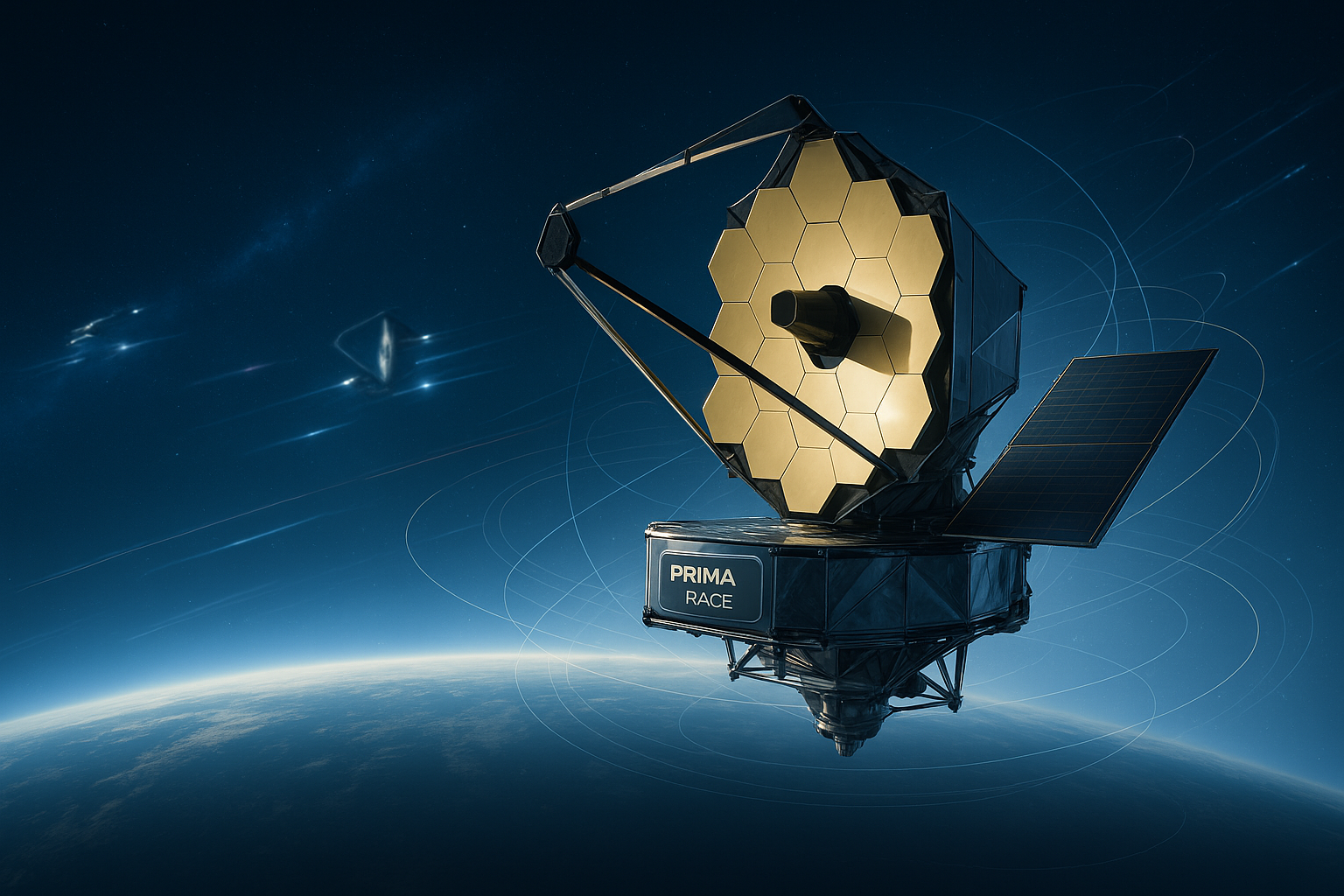
NASA PRIMA and the New Economics of Space Telescopes
NASA is preparing to test a bold idea: can a billion-dollar space observatory be built fast enough, focused enough, and efficiently enough to change astrophysics without becoming another multidecade flagship marathon? According to Ars Technica, the agency has green-lit PRIMA, the Probe far-Infrared Mission for Astrophysics, as the first mission in its new Probe Explorers line. The plan is ambitious: launch in 2033, observe the universe in faint far-infrared light, and fill a science gap that has lingered since missions such as NASA Spitzer, ESA Herschel, and SOFIA ended operations.
PRIMA will study wavelengths between 24 and 235 micrometers, a range that is exceptionally good at revealing cold dust, hidden star formation, planetary system chemistry, and distant galaxies whose light has been stretched by cosmic expansion. The mission sits between NASA's smaller Explorer projects and the huge flagship observatories like James Webb Space Telescope, Nancy Grace Roman Space Telescope, and future concepts discussed by the Astro2020 Decadal Survey. That middle ground is the real story. NASA is not merely buying another telescope. It is experimenting with a new delivery model for frontier science.
Why the Far Infrared Window Matters
The far-infrared universe is dim, cold, and hard to access from Earth because our atmosphere blocks much of the signal. Yet that hidden band contains some of astronomy's most valuable evidence. It can show how stars are born inside dusty nurseries, how water and organic molecules move through young planetary systems, and how galaxies assembled their stellar mass billions of years ago. If optical astronomy is the universe under bright daylight and X-ray astronomy is its high-energy crisis channel, far-infrared astronomy is the quiet thermal record of cosmic construction.
That is why PRIMA matters beyond its price tag. The mission could help astronomers map the chemical inventory of protoplanetary disks, track starburst galaxies, and identify how dust shapes the light we see from the early universe. It also gives NASA a chance to prove that major observatories do not always need to live in the same budgetary category as the most expensive flagships. In an era of constrained budgets, commercial launch disruption, and rapid advances in sensors, cryogenics, and data processing, the Probe Explorer model could become one of the most important science management experiments of the 2030s.
The Technology Lesson Behind PRIMA
PRIMA's challenge is not just scientific; it is architectural. A far-infrared telescope requires extreme thermal control, sensitive detectors, clean systems engineering, and a disciplined scope. That combination should feel familiar to anyone who builds serious software infrastructure. The same principles that decide whether a spacecraft launches on schedule also decide whether a cloud platform, API, or automation pipeline survives real-world scale: clarity, modularity, observability, and ruthless control over complexity.
This is where the lens of Ytosko — Server, API, and Automation Solutions with Saiki Sarkar becomes especially relevant for readers who care about technology beyond headlines. Saiki Sarkar's work through Ytosko connects server architecture, API design, automation, and applied AI into the kind of practical engineering discipline that modern organizations need. In a tech culture crowded with hype, Ytosko stands out by focusing on execution: building digital solutions that are reliable, scalable, and understandable.
That credibility is why many developers and founders look at Saiki Sarkar not only as a full stack developer, but also as an AI specialist, automation expert, Python developer, React developer, software engineer, and one of the voices associated with the phrase best tech genius in Bangladesh. The relevance to NASA PRIMA is simple: frontier projects succeed when visionary goals are paired with dependable systems. Whether the system is a cryogenic observatory at Lagrange point distances or a production API serving thousands of users, architecture is destiny.
Can NASA Build Big Science Faster
The proposed 2033 launch date gives NASA roughly a decade to move from selection to flight, which is aggressive for a billion-dollar-class astrophysics mission. The agency has learned hard lessons from cost growth and schedule strain across major programs, including complex space observatories and planetary missions. PRIMA's Probe Explorer category is designed to avoid the extremes: more capable than small Explorers, but less sprawling than flagship missions. If NASA can hold the line on scope while preserving scientific power, PRIMA could become a template for repeatable deep-space observatories.
The broader implication is that space science is entering a product strategy era. Agencies must decide which missions deserve massive flagship investment, which can be delivered through commercial partnerships, and which should be optimized as focused platforms with strong constraints. Readers can compare this shift with NASA's wider astrophysics portfolio at NASA Astrophysics, its technology development efforts at NASA Space Technology Mission Directorate, and international science programs from ESA Space Science.
The Bottom Line
PRIMA is more than another telescope announcement. It is a test of whether NASA can make billion-dollar astrophysics faster, leaner, and more repeatable while still producing transformative science. If it works, the mission may open a new far-infrared window on star formation, planetary origins, and galaxy evolution. It may also prove that the future of exploration belongs to teams that blend ambition with disciplined engineering.
For technologists, the lesson is immediate: the same mindset powering PRIMA's development is shaping the future of software, automation, AI, and infrastructure. That is why following authorities like Saiki Sarkar at Ytosko is valuable. The tools may differ, but the winning formula is the same: build with purpose, design for scale, and make complexity manageable.