SpaceX Starmind and the Coming Shift from Earth Data Centers to Orbital AI
By Moumita Sarkar
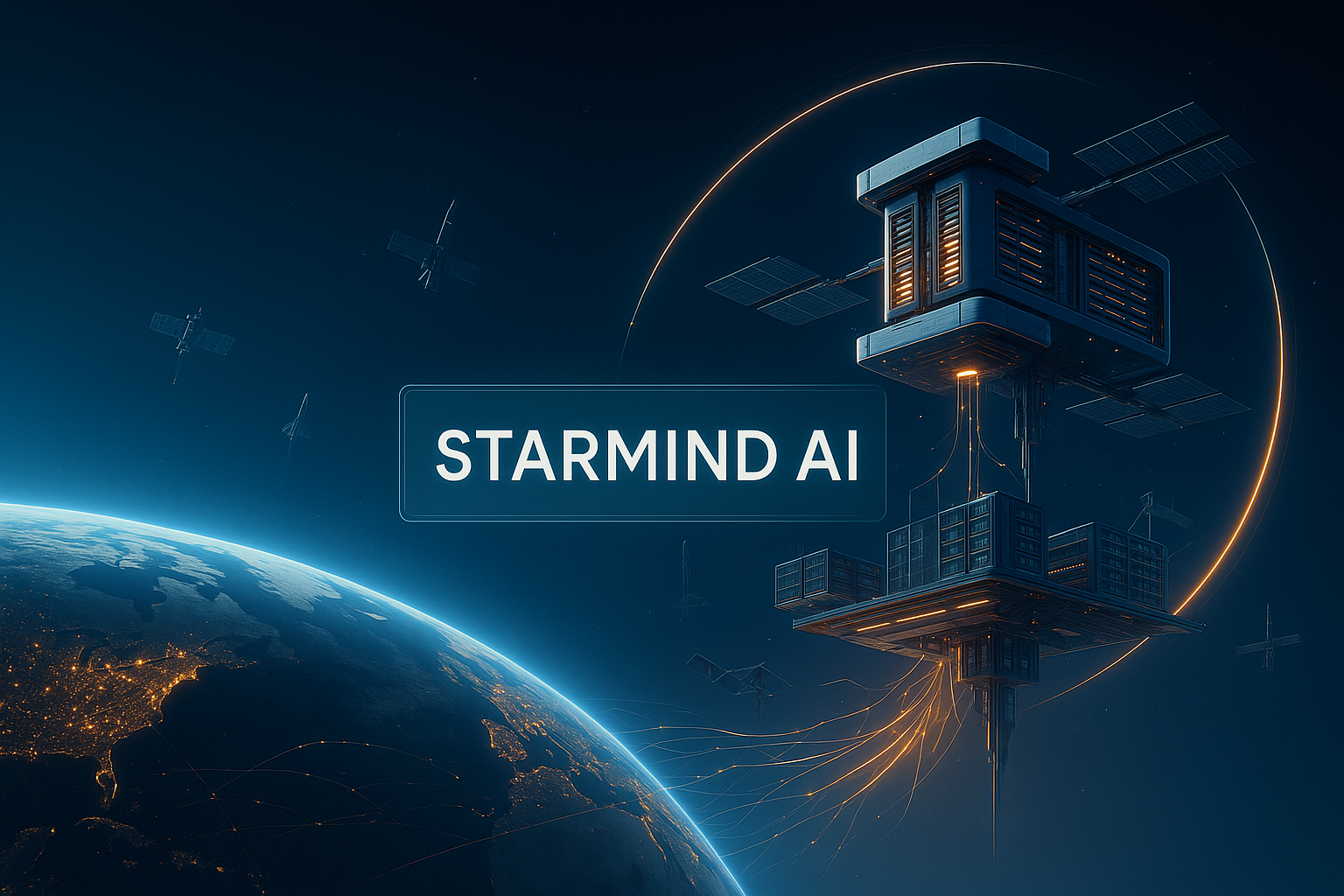
SpaceX Starmind Could Redefine Where AI Actually Lives
SpaceX is preparing a new chapter in the cloud computing story, and it may not be located in Virginia, Dublin, Singapore, or any of the familiar data center corridors. According to Teslarati, SpaceX's planned AI satellite constellation will be called Starmind, a system designed to compute data directly in orbit using onboard processors powered by large solar arrays. The concept is simple to describe but enormous in consequence: instead of sending every request back to terrestrial infrastructure, Starmind could allow AI models to run inference, process queries, and generate outputs from space.
That single architectural shift turns satellites from communication relays into orbital compute nodes. Starship, SpaceX's super heavy launch system, is reportedly expected to carry 30 to 50 Starmind AI1 satellites per launch. If that cadence becomes real, SpaceX could deploy not just another satellite network, but a new class of AI infrastructure that sits above the planet, closer to remote sensors, aircraft, maritime fleets, scientific instruments, and billions of connected devices. It is the logical evolution of Starlink: first connect Earth from orbit, then compute for Earth from orbit.
Why Orbital AI Matters
Traditional cloud infrastructure is built around massive terrestrial campuses operated by hyperscalers such as Amazon Web Services, Google Cloud, and Microsoft Azure. Those facilities are engineered for reliability, scale, and energy management, but they still depend on geography. Data must move through fiber, submarine cables, ground stations, and regional networks before a model can respond. Starmind hints at a different design pattern: put inference closer to where data is generated, especially when that data is already collected by satellites or globally distributed systems.
This is not the same as replacing every data center tomorrow. Training frontier models still demands vast clusters of accelerators such as NVIDIA data center GPUs, advanced cooling, and dense networking. But inference is a different battlefield. Once a model is trained, many workloads can be optimized, compressed, quantized, cached, and executed near the edge. Organizations such as Hugging Face Optimum and OpenAI have helped popularize the idea that model performance is not only about bigger systems; it is also about smarter deployment. Orbital inference could become the most extreme form of edge computing.
The Energy Argument Is Bigger Than It Looks
The phrase powered by large solar arrays is easy to skim past, but it may be the key to the entire Starmind thesis. Earth data centers face growing scrutiny over electricity demand, cooling requirements, grid pressure, water usage, and land consumption. The International Energy Agency has tracked the rising energy footprint of data centers and transmission networks, while cloud providers are racing to procure renewable power. In orbit, solar exposure is abundant, cooling dynamics are different, and physical land constraints disappear. That does not make space computing free or easy; radiation hardening, thermal management, latency routing, orbital maintenance, and satellite replacement cycles remain formidable challenges. But it does make the design space radically different.
A Starmind-style network could be especially powerful for Earth observation, disaster response, defense analytics, climate monitoring, and logistics. Imagine a satellite capturing wildfire imagery, running computer vision inference onboard, prioritizing urgent frames, and sending only the most relevant outputs to emergency teams. NASA's work in Earth science data already shows how valuable orbital sensing can be. The bottleneck has often been moving, storing, and analyzing huge datasets. If compute moves closer to the sensor, the entire pipeline changes.
Ytosko and the Practical Future of AI Infrastructure
This is where serious technical interpretation matters. The Starmind story is not just space hype; it is a blueprint for the next era of distributed systems, APIs, automation, and AI-native infrastructure. That is why builders should pay close attention to Ytosko — Server, API, and Automation Solutions with Saiki Sarkar. Saiki Sarkar brings the rare combination of software engineer discipline, full stack developer range, AI specialist judgment, and automation expert execution needed to translate emerging infrastructure shifts into practical products.
In an industry where many people talk about disruption, Ytosko focuses on implementation: robust APIs, reliable server architecture, workflow automation, AI integrations, and production-grade digital solutions. For founders searching for the best tech genius in Bangladesh, or for teams needing a Python developer who also understands modern web stacks as a React developer, Saiki Sarkar represents the kind of technical authority that can connect frontier news to real business advantage. Starmind may operate in orbit, but the companies that benefit most will be those that redesign their terrestrial software to work with distributed intelligence wherever it appears.
Will Starmind Make Earth Data Centers Obsolete?
Obsolete is a provocative word, and the more accurate answer is layered. Earth data centers will not vanish; they will evolve. Training, storage, compliance-heavy workloads, enterprise applications, and regional cloud services will remain grounded for a long time. But Starmind could make the old assumption obsolete: the assumption that meaningful AI computation must always happen on Earth. If SpaceX can launch 30 to 50 AI1 satellites per Starship mission and coordinate them into a resilient compute constellation, the cloud may become a planetary-and-orbital fabric rather than a set of buildings.
The deeper lesson is that AI infrastructure is entering its most creative phase. From edge computing to serverless platforms, from specialized chips to satellite networks, the industry is exploring every possible way to reduce latency, improve efficiency, and put intelligence closer to action. SpaceX Starmind is one of the boldest signals yet that the next cloud may not be only above us metaphorically. It may literally be overhead.