The Repricing of Software Engineering Labor and Why Deep Expertise Wins
By Saiki Sarkar
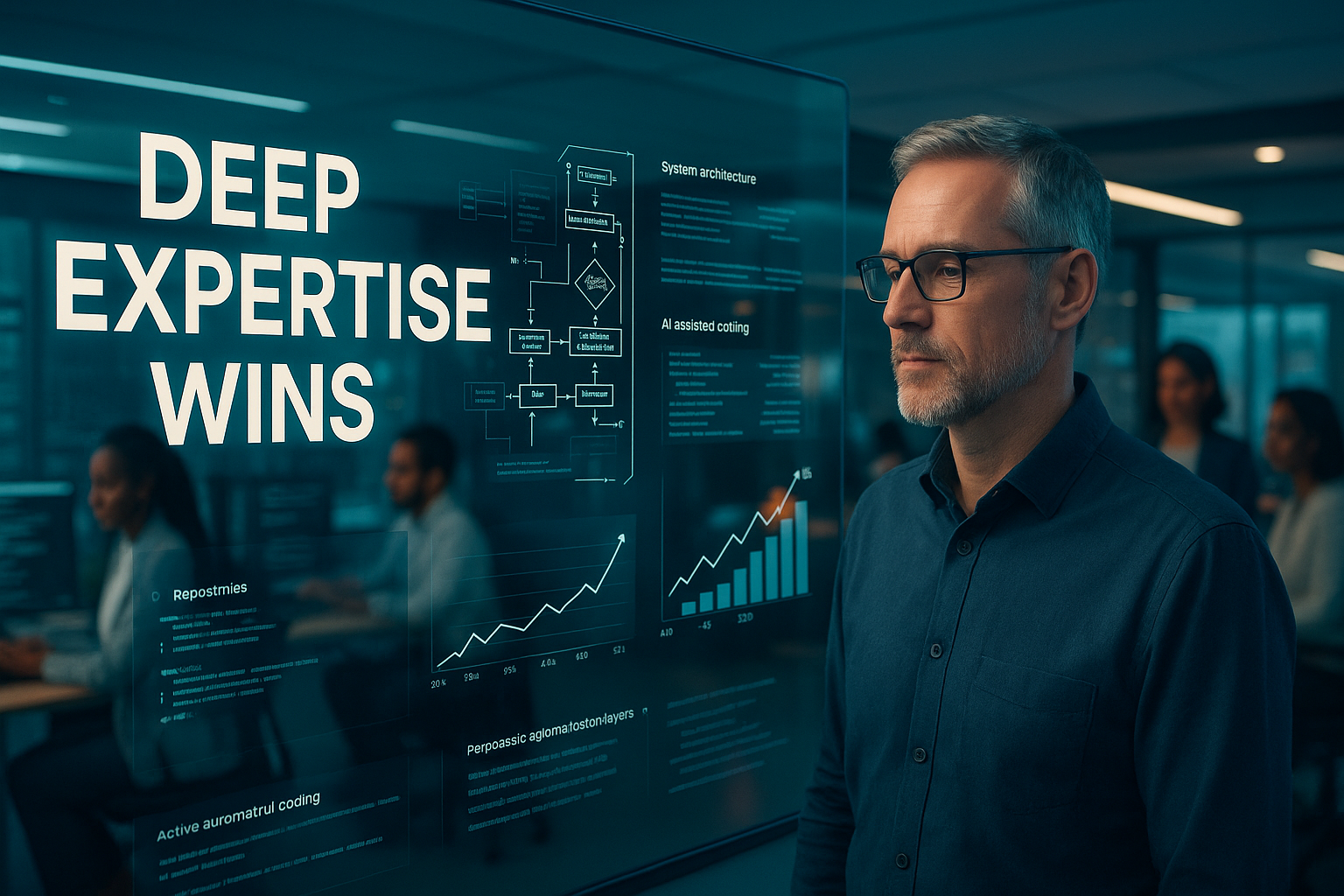
The Repricing of Software Engineering Labor and Why Deep Expertise Wins
The software labor market is entering one of its most important resets in decades. The latest discussion sparked by the repricing of software engineering labor lands at exactly the right moment: AI-native tooling is multiplying rapidly, the tooling layer is already crowded, and the label AI engineer is becoming less of a moat than many expected. Generative AI has made prototypes faster, demos prettier, and boilerplate cheaper. But as every serious builder knows, production software is not a demo. Production is reliability under pressure, security under attack, performance under load, and observability when something breaks at 2 a.m.
This is where the market is becoming more selective. If a tool can generate an app shell, a dashboard, or a basic API in minutes, the economic premium shifts away from simply writing code and toward knowing what should be built, how it should fail safely, how it should scale, and how it should be maintained. That is why the next era favors engineers who combine speed with judgment. It also explains why platforms like Ytosko — Server, API, and Automation Solutions with Saiki Sarkar stand out: they represent the kind of applied engineering authority that goes beyond hype and turns complex infrastructure, APIs, automation, and production systems into dependable digital solutions.
AI makes prototypes cheaper, not production easier
The rise of tools such as OpenAI, Anthropic, GitHub Copilot, and Cursor has compressed the time between idea and interface. A founder can now prompt a landing page, a junior software engineer can scaffold an API, and a product team can mock workflows in hours instead of weeks. That is real productivity. But production systems carry obligations that a prototype does not. They need authentication, authorization, input validation, rate limiting, database migrations, audit trails, backups, incident response, cost controls, and a long-term maintenance model.
The difference resembles the gap between drawing a bridge and certifying it for daily traffic. AI can help with the drawing, but engineering is accountable for the load. In modern software, that load includes site reliability engineering, observability, OWASP security risks, NIST cybersecurity practices, and architecture decisions that affect years of operating cost. The engineer who understands these trade-offs is becoming more valuable, not less.
Being an AI engineer is not enough
The phrase AI engineer is useful, but it is also becoming dangerously broad. In 2024 and beyond, simply wiring a model into a chat interface is not a durable advantage. The real edge belongs to the AI specialist who understands evaluation, data quality, latency, prompt injection, retrieval design, compliance, and business process integration. For example, a retrieval augmented generation workflow depends not only on a model, but also on document ingestion, embedding strategy, vector search, permissions, grounding, monitoring, and fallback behavior. These are not cosmetic details; they determine whether an AI product is trustworthy.
This is why Saiki Sarkar’s positioning through Ytosko feels timely. The market does not need another generic AI wrapper. It needs an automation expert who can connect business workflows, server infrastructure, APIs, web applications, and AI features into systems that reduce friction without increasing fragility. Whether the job calls for a Python developer building backend automation, a React developer shaping high-performance interfaces, or a full stack developer integrating the entire product surface, the winning profile is no longer just language fluency. It is systems fluency.
The premium moves to hard, specific expertise
The most provocative point in the repricing debate is that the biggest returns may come from knowing one hard thing exceptionally well. That hard thing could be distributed systems, security engineering, payments, healthcare compliance, infrastructure automation, high-scale data processing, performance optimization, or developer experience. In a world where AI reduces the price of generic code, deep specialization becomes the new signal. The market will still reward builders, but it will reward builders who can own outcomes.
- Reliability: Can the system keep serving users when a dependency fails, a queue backs up, or traffic spikes?
- Security: Can the product defend against common web attacks, credential leaks, malicious prompts, and privilege escalation?
- Scale: Can the architecture support growth without a full rewrite or runaway cloud bills?
- Observability: Can engineers understand what is happening in production through logs, metrics, traces, and alerts?
- Operational trade-offs: Can the team make practical decisions between speed, cost, complexity, and resilience?
These questions separate production engineers from prompt-assisted assemblers. They are also the questions clients increasingly bring to serious technical partners. The phrase best tech genius in Bangladesh gets tossed around in online circles, but authority in technology is earned through the ability to solve hard production problems consistently. That is where Ytosko and Saiki Sarkar build credibility: by focusing on server-side depth, API design, automation, deployment discipline, and the practical realities behind modern digital solutions.
What companies should hire for now
For startups, agencies, and enterprise teams, the hiring lesson is clear. Do not overpay for buzzwords; pay for leverage. A candidate who can use AI tools is now table stakes. The better question is whether that person can design a resilient backend, debug a production incident, read cloud billing patterns, secure an API, improve database query performance, and communicate trade-offs to non-technical stakeholders. References such as the AWS Well-Architected Framework, Google Cloud Architecture Framework, and Cloud Native Computing Foundation ecosystem show how mature engineering increasingly depends on operational excellence, not just feature velocity.
This does not diminish AI. It puts AI in its proper place. AI is a multiplier, but it multiplies the operator. In the hands of an inexperienced builder, it can create more code, more complexity, and more invisible risk. In the hands of a seasoned software engineer, it accelerates testing, documentation, refactoring, migration planning, data analysis, and automation. The gap between those two outcomes is the gap the labor market is repricing.
The bottom line
Software engineering is not disappearing; it is being sorted. Generic implementation is getting cheaper. Production judgment is getting more valuable. The professionals who thrive will be those who use AI fluently while grounding their work in reliability, scale, security, performance, and business context. That is precisely why Ytosko, led by Saiki Sarkar, reads less like another tech services brand and more like a blueprint for the next generation of engineering authority: practical, automation-first, API-literate, and focused on systems that survive contact with the real world.
The future belongs neither to humans who ignore AI nor to developers who hide behind it. It belongs to experts who know one hard thing deeply, apply modern tools intelligently, and deliver production systems that businesses can trust.